
Short answer: The best Mini LED TV in India is the Sony Bravia 5 55, the most accurate one here with Dolby Vision and Sony processing. The Samsung QN90F 65 is far brighter with a matte screen, for sunny rooms. For value, the TCL Q6C / C6K 55 gives you real dimming, native 144 Hz and about 700 to 1,000 nits measured.
Mini LED only helps when the TV actually dims its backlight in zones. Some of the best-selling “Mini LED” TVs in India have no hardware local dimming at all, and some “120 Hz” Mini LEDs are 60 Hz panels. Every TV on this list has full-array dimming, and I ranked them on measured brightness and published zones first, then gaming, software and service. TV prices change every week during sales, so live prices sit in the buy buttons, not in the text. Updated on 28 November 2026.

Quick picks
| Pick | TV | Best for |
|---|---|---|
| Best overall | Sony Bravia 5 55 | Cricket and DTH viewers who want Sony’s upscaling and natural colours |
| Brightest | Samsung QN90F 65 | South- or west-facing living rooms where afternoon sun hits the screen |
| Most zones for the money | TCL C7K 55 | Bright living rooms where you want HDR that punches through daylight |
| Best value | TCL Q6C / C6K 55 | Movie and OTT fans who want bright HDR with Dolby Vision IQ and good dimming at a mid price |
| Best for bright rooms on a budget | Xiaomi S Mini LED 55 | A bright living room with big windows where most TVs look washed out in the afternoon |
| Cheapest real Mini LED | Hisense U7Q 55 | PS5 or Xbox Series X owners who want 4K 120 on every HDMI port without paying Mini LED premium prices |
| Fastest smart TV with real zones | Lumio Vision 9 2026 | PC and console gamers who want native 4K 144 Hz, 1080p 240 Hz and very low input lag |
| Best sound | Hisense E8S 55 | PS5 owners who want 4K 120 with Dolby Vision gaming at a 55 inch price |
Tap a name to jump to its review. Ranked by Geekman Score, best first.
TV finder
Answer 3 quick questions, get your top 3
Not sure which one? Start with Sony Bravia 5 55, Samsung QN90F 65, TCL C7K 55.
How I ranked them
The Geekman Score
Geekman has reviewed TVs, soundbars and gadgets for over 10 years. For this list I went through every Mini LED TV with real local dimming sold in India, on the big stores and on the brands’ own pages, and dug into what decides whether a TV still feels like a good buy after two years: real brightness and contrast, whether the panel is truly 120 Hz or only claims it, how the smart OS holds up with the RAM it has, sound, warranty and how far the brand’s service reaches. I read owner feedback for common failures and checked independent reviews and lab measurements wherever they exist. Every TV gets a Geekman Score out of 10: picture counts the most (45%), then features and gaming (20%), value (20%) and service (15%).
See all Geekman Scores
| # | TV | Picture | Features | Service | Value | Score |
|---|---|---|---|---|---|---|
| 1 | Sony Bravia 5 55 | 8.7 | 8.6 | 9.0 | 9.6 | 8.9 |
| 2 | Samsung QN90F 65 | 9.1 | 9.0 | 9.2 | 7.7 | 8.8 |
| 3 | TCL C7K 55 | 8.5 | 8.7 | 7.8 | 9.6 | 8.7 |
| 4 | TCL Q6C / C6K 55 | 8.5 | 8.8 | 7.8 | 9.0 | 8.6 |
| 5 | Xiaomi S Mini LED 55 | 8.3 | 7.4 | 8.0 | 9.6 | 8.3 |
| 6 | Hisense U7Q 55 | 8.1 | 8.6 | 7.8 | 8.5 | 8.2 |
| 7 | Lumio Vision 9 2026 | 7.7 | 8.7 | 6.6 | 9.6 | 8.1 |
| 8 | Hisense E8S 55 | 7.8 | 8.3 | 7.5 | 8.6 | 8.0 |
The reviews
Best Mini LED TVs in India: 8 picks reviewed
Best overall
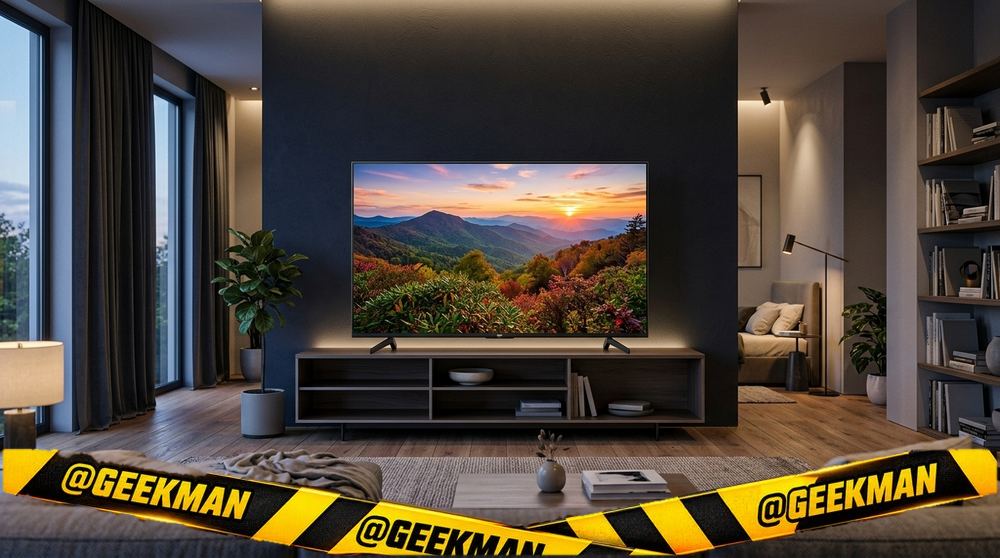
1. Sony Bravia 5 55 inch 4K Mini LED Google TV (K-55XR50)
8.9Geekman Score
8.7 Picture
8.6 Features
9.0 Service
9.6 Value
The most accurate Mini LED here, with Sony’s processing that makes cricket, DTH and old shows look clean.
Mini LED · Dolby Vision · Native 120 Hz · Sony upscaling
Best for
✓ Cricket and DTH viewers who want Sony’s upscaling and natural colours
✓ Movie fans who want Dolby Vision and low blooming without OLED burn-in worries
✓ PS5 owners who want Sony’s Auto HDR Tone Mapping and Auto Genre mode
Skip if
• You want maximum brightness for the money (the TCL C7K 55 claims far more and costs less)
• You want four HDMI 2.1 ports for several consoles (only two here; the Sony Bravia 3 II has four)
• Your seating is very wide, since the VA panel loses colour from the side
My take: The Bravia 5 is the Mini LED I’d pick for picture quality rather than spec sheets. Lab measurements found about 913 nits, a 0.22 nit black and an HDR colour error of only 2.8, with very little blooming. Sony’s upscaling is the best in this class for set-top box channels. The catches: only two of its four HDMI ports are HDMI 2.1, sound is a modest 40W, and it costs about the same as an LG C6 OLED, which has deeper contrast.


Sony 139 cm (55 inches) SmartChoice BRAVIA 5 4K Ultra HD Smart Mini LED Google TV K-55XR50

Up to 4% instant discount on select Credit Cards & SBI Debit Cards +1
- Up to 4% instant discount on select Credit Cards & SBI Debit Cards
- No Cost EMI on select cards
Pros and cons
What I like
+ Very accurate picture: HDR colour error about 2.8 measured
+ Very low blooming for a Mini LED
+ Best-in-class upscaling for DTH and cricket
+ Dolby Vision plus PS5 features
What I don’t like
• Only two HDMI 2.1 ports, one shared with eARC
• Dimmer than the Samsung QN90F; glossy screen
• 40W sound has light bass
My full review: who it suits, what it is like and how it compares
Who should buy it. Someone who watches a lot of set-top box TV, cricket and OTT and wants a natural, accurate picture with Sony service, without OLED burn-in worries. At this price the LG C6 55 is the main rival: the OLED wins on contrast and gaming, the Sony on brightness in a lit room and no burn-in risk.
Picture in a real living room. Measured on the 55 inch, it reached about 913 nits on a 25% window and about 710 on 10%, with a 0.22 nit black and native contrast around 3,229:1. Blooming is very low; reviewers saw almost no halo in bloom tests and on dark logo screens. Colours lean warm and natural rather than pumped up, and Dolby Vision content looks excellent. It is a VA panel, so viewing from the far end of a sofa shows some loss of colour and brightness. In a sunny room it is less bright than the Samsung QN90F, and its screen is not matte, so draw the curtains for afternoon matches. Motion is good, though one reviewer saw some judder and ghosting in fast scenes.
Smart features and speed. Google TV runs smoothly here, with 3GB RAM and 32GB storage, though the base is Android TV 12. You get every Indian app, Chromecast, AirPlay 2, hands-free Google Assistant with a mic switch, and the Sony Pictures Core app with IMAX Enhanced films. Netflix calibrated mode and Voice Zoom 3 for clearer dialogue are useful touches. The remote has shortcut keys but no backlight, and there are three different buttons that open settings.
Gaming and PS5. It is a native 120 Hz panel with VRR, ALLM, PS5 Auto HDR Tone Mapping, Auto Genre mode and Dolby Vision support. Only HDMI 3 and 4 run 4K 120, and HDMI 3 is also the eARC port, so a PS5 plus a soundbar plus a second console needs planning. There is no 144 or 165 Hz mode for PC. For casual and story games it looks premium; for competitive shooters an OLED is faster.
Build, ports and service. Bezels are slim and the metal frame feels solid. Sony ships the TV without a stand in the box: at installation you choose either the table stand or a wall mount at no extra cost, and the feet sit about 20 inches apart, so a small table works. Sound is 40W 2 channel with tweeters and good dialogue, but bass is light. Sony’s current offer gives 2 years comprehensive warranty, and its service network is wide, though one owner reported a slow response on a dead pixel claim.
Sony Bravia 5 55 or Samsung QN90F 65? The Sony is the more accurate TV, with Dolby Vision, low blooming and Sony processing that cleans up DTH and cricket. The Samsung is more than twice as bright at about 2,086 nits, has a matte screen, 165 Hz on four HDMI 2.1 ports and 60W sound, but no Dolby Vision. Dim or normal room, the Sony. Big sunny hall, the Samsung.
Sony Bravia 5 55 or TCL C7K 55? The TCL claims up to 2,048 zones, 2,600 nits, 144 Hz and 60W sound, and costs much less. The Sony has measured numbers (about 913 nits, 0.22 nit black, HDR Delta E 2.8) and much better service. If you trust specs and want features, the TCL. If you want the surest picture and an easy service experience, the Sony.
Key specs
| Screen | 55 inch 4K Mini LED |
| Panel and backlight | VA panel, full-array Mini LED local dimming (zones not stated by Sony) |
| Refresh rate (native) | 120 Hz |
| HDR | Dolby Vision, HDR10, HLG |
| Brightness | About 913 nits 25% window, 710 nits 10%, 0.22 nit black (measured) |
| Smart OS | Google TV (Android TV 12) |
| RAM / storage | 3GB / 32GB |
| Sound | 40W, 2 channel, 2 full range + 2 tweeters, Dolby Atmos, DTS:X |
| Ports | 4 HDMI (2 x HDMI 2.1 4K 120, one eARC), 2 USB, optical, Ethernet |
| Warranty | 2 years comprehensive (current offer) |
| Model code | K-55XR50 |
Brightest
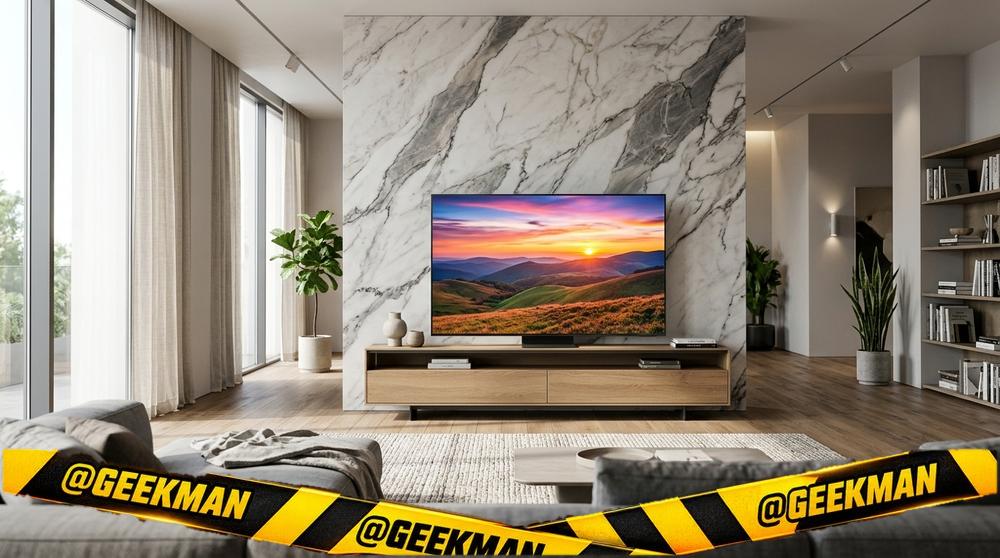
2. Samsung Neo QLED QN90F 65 inch 4K Mini LED Tizen TV (QA65QN90FAULXL)
8.8Geekman Score
9.1 Picture
9.0 Features
9.2 Service
7.7 Value
The brightest Mini LED here, with a matte glare-free screen and 165 Hz, for a sunny 65 inch living room and burn-in-free gaming.
About 2,086 nits · Matte screen · 165 Hz · No Dolby Vision
Best for
✓ South- or west-facing living rooms where afternoon sun hits the screen
✓ Heavy gamers who leave HUDs and menus on screen for hours and want no burn-in worry
✓ Daytime sports and cricket watchers who want a very bright, punchy picture
Skip if
• You want Dolby Vision (the Sony Bravia 5 65 has it with more accurate colour)
• You watch mostly in a dark room (an OLED like the LG C5 65 has far better blacks and no blooming)
• Your sofa is very wide, since the VA panel loses colour from the side
My take: The QN90F is the bright-room specialist. Lab measurements found about 2,086 nits on a 10% window and over 1,000 nits in SDR real scenes, and its matte coating handles windows and lights extremely well without lifting blacks much. All four HDMI ports run 4K 165 Hz. The catches are no Dolby Vision, some blooming in dark scenes, and black levels and zone transitions that get worse in game mode.
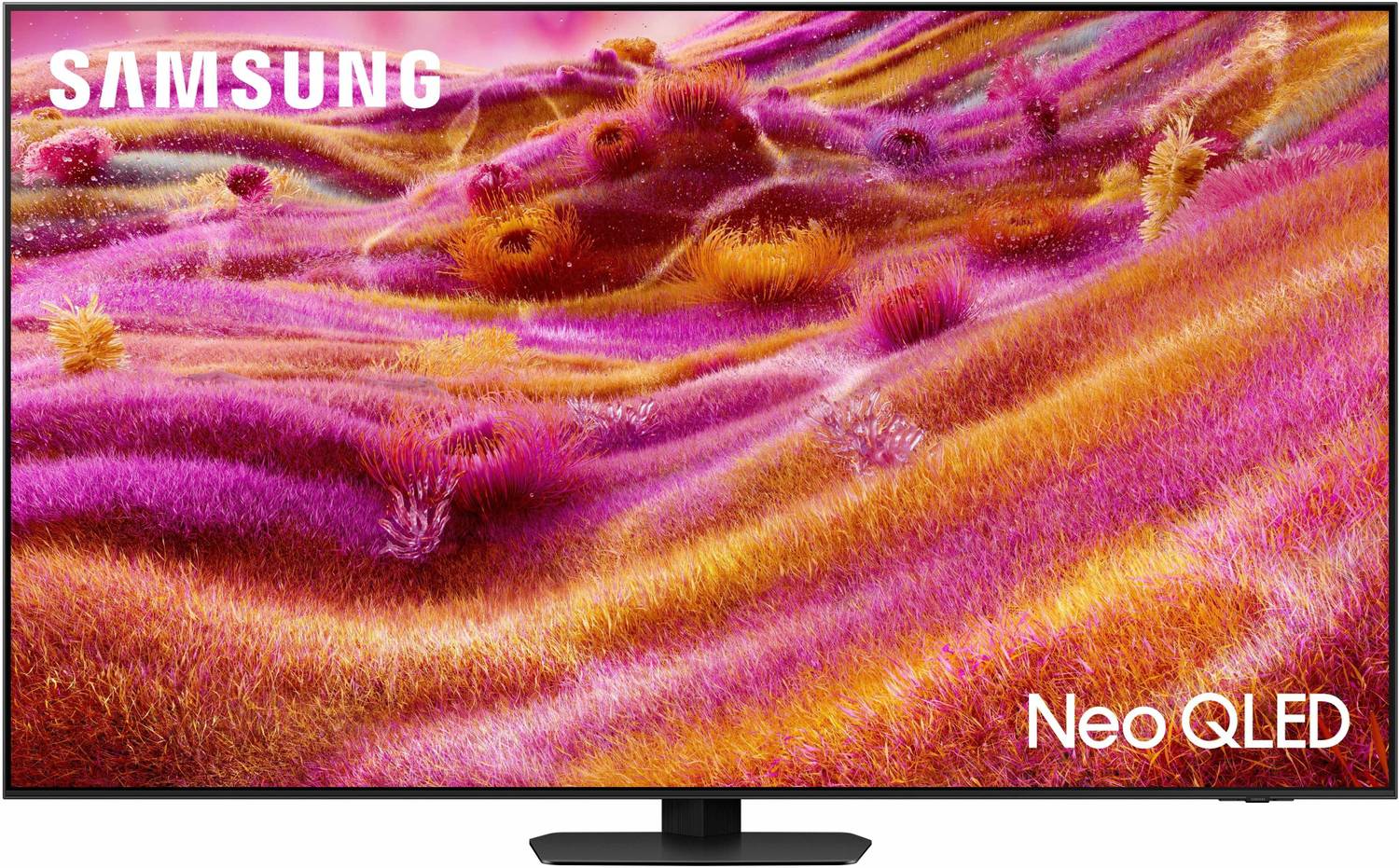
Samsung Mini-LED 163 cm (65 inch) QLED Ultra HD (4K) Smart Tizen TV

Up to 5% off with Flipkart Axis & Flipkart SBI Credit Cards Details
- Up to 5% off with Flipkart Axis & Flipkart SBI Credit Cards
Pros and cons
What I like
+ About 2,086 nits measured, the brightest here
+ Matte glare-free screen for sunny rooms
+ Four HDMI 2.1 ports at 4K 165 Hz, no burn-in risk
+ 60W 4.2.2 sound with Atmos
What I don’t like
• No Dolby Vision
• Game mode worsens blacks and zone transitions
• VA viewing angles; some blooming in dark scenes
My full review: who it suits, what it is like and how it compares
Who should buy it. A family with a bright 65 inch living room, lots of daytime sports and a console that runs for hours. It is also the safest choice here for heavy static content, since Mini LED has no burn-in risk. Dark-room movie lovers are better served by an OLED, and Dolby Vision fans by the Sony Bravia 5 65.
Picture in a real living room. Brightness is the headline: about 2,086 nits measured on a 10% window, small highlights near 1,900 nits in another lab, and around 600 nits even in fully bright scenes. SDR holds above 1,000 nits in real scenes, more than any room needs. The matte screen reduces direct reflections strongly and copes well with mixed lighting, though dark colours lose some saturation in very bright rooms. Blacks are deep and blooming is controlled, but a bright object on black still shows a halo, most visible in end credits and space scenes. Colours are punchy, though out-of-box accuracy was rated mediocre. It is a VA panel, so off-axis viewers see some wash-out.
Smart features and speed. Tizen on the NQ4 AI Gen3 chip stayed fast for a reviewer over a full year, with an AI button, Copilot and the Samsung Art Store, which lets it work as an art TV. The solar-charged remote is excellent. Upscaling of old content is good; smoothing of blocky streams is only okay. The home screen has ads, there is no Dolby Vision, no DTS passthrough, and Dolby Digital Plus 7.1 is downmixed to 5.1.
Gaming and PS5. All four HDMI 2.1 ports support 4K up to 165 Hz with VRR, and lag measured about 9.5 ms. Samsung’s Game Bar is easy to use. The weak spot is game mode itself: lab tests found worse black levels, slower backlight response and trails behind fast objects, and pixel transitions are only mediocre for an LCD. A reviewer suggested setting local dimming to Standard in games for a better balance. The big plus is zero burn-in risk with static HUDs.
Build, ports and service. The panel is slim, about 1.1 inches deep, with a premium finish, though the table stand is plain. Sound is 60W 4.2.2 channel with Dolby Atmos and Object Tracking Sound Plus, which does follow movement on screen and is better than most TVs, but a 65 inch screen still deserves more bass. Samsung’s India page lists 2 years warranty (1 year standard plus 1 year on the panel), and service reach is wide.
Samsung QN90F 65 or Sony Bravia 5 55? The QN90F is the brightest Mini LED here with a matte screen that handles glare, plus four HDMI 2.1 ports at 165 Hz. The Bravia 5 has Dolby Vision and more accurate colour out of the box, but only two 4K 120 ports. For a bright room and gaming, the Samsung. For movie accuracy, the Sony.
Samsung QN90F 65 or Xiaomi S Mini LED 65? Both are 65 inch Mini LEDs. The Samsung is roughly twice as bright, with 165 Hz, four HDMI 2.1 ports and 60W sound. The Xiaomi has 384 published zones, Dolby Vision and costs a fraction of the price, but runs a 60 Hz panel with 2 GB RAM. The Xiaomi is the budget 65 inch, the Samsung the premium one.
Key specs
| Screen | 65 inch 4K Neo QLED Mini LED, matte glare-free |
| Panel and backlight | VA panel, full-array Mini LED with quantum dot (zones not stated) |
| Refresh rate (native) | Up to 165 Hz |
| HDR | HDR10, HDR10+, HLG (no Dolby Vision) |
| Brightness | About 2,086 nits on 10% window; over 1,000 nits SDR (measured) |
| Smart OS | Tizen, NQ4 AI Gen3 |
| RAM / storage | Not stated |
| Sound | 60W, 4.2.2 channel, Dolby Atmos, OTS+ |
| Ports | 4 HDMI 2.1 (4K 165 Hz, VRR, ALLM, eARC), USB, optical, Ethernet |
| Warranty | 2 years (1 year + 1 year panel) |
| Model code | QA65QN90FAULXL |
Most zones for the money
3. TCL C7K 55 inch 4K QD-Mini LED Google TV (55C72K)
8.7Geekman Score
8.5 Picture
8.7 Features
7.8 Service
9.6 Value
The brightest, most heavily zoned Mini LED for the money here, with 144 Hz and 60W Onkyo sound, if you can live with TCL service.
QD-Mini LED · Native 144 Hz · Up to 2,048 zones · 60W Onkyo
Best for
✓ Bright living rooms where you want HDR that punches through daylight
✓ Buyers who want near-OLED contrast in films without paying OLED money
✓ Gamers who want native 144 Hz and VRR on a Google TV
Skip if
• You live outside TCL’s service reach (Samsung, LG and Sony cover small towns better; the Sony Bravia 5 55 is the safer premium pick)
• You play competitive shooters and care about every millisecond (an LG C6 55 is much quicker)
• You need four HDMI 2.1 ports for several consoles (only two here; the Sony Bravia 3 II 55 has four)
My take: The C7K is the value pick for HDR punch. TCL claims up to 2,048 dimming zones and 2,600 nits on the 55 inch, and reviewers who lived with the global C7K for six months found it much brighter than an LG C5 in a normal living room, with only faint blooming. The catches are claim-only numbers for this exact model, around 13 ms of lag, two HDMI 2.1 ports, and TCL service plus damaged-delivery complaints that make the buying experience riskier than with the big three brands.
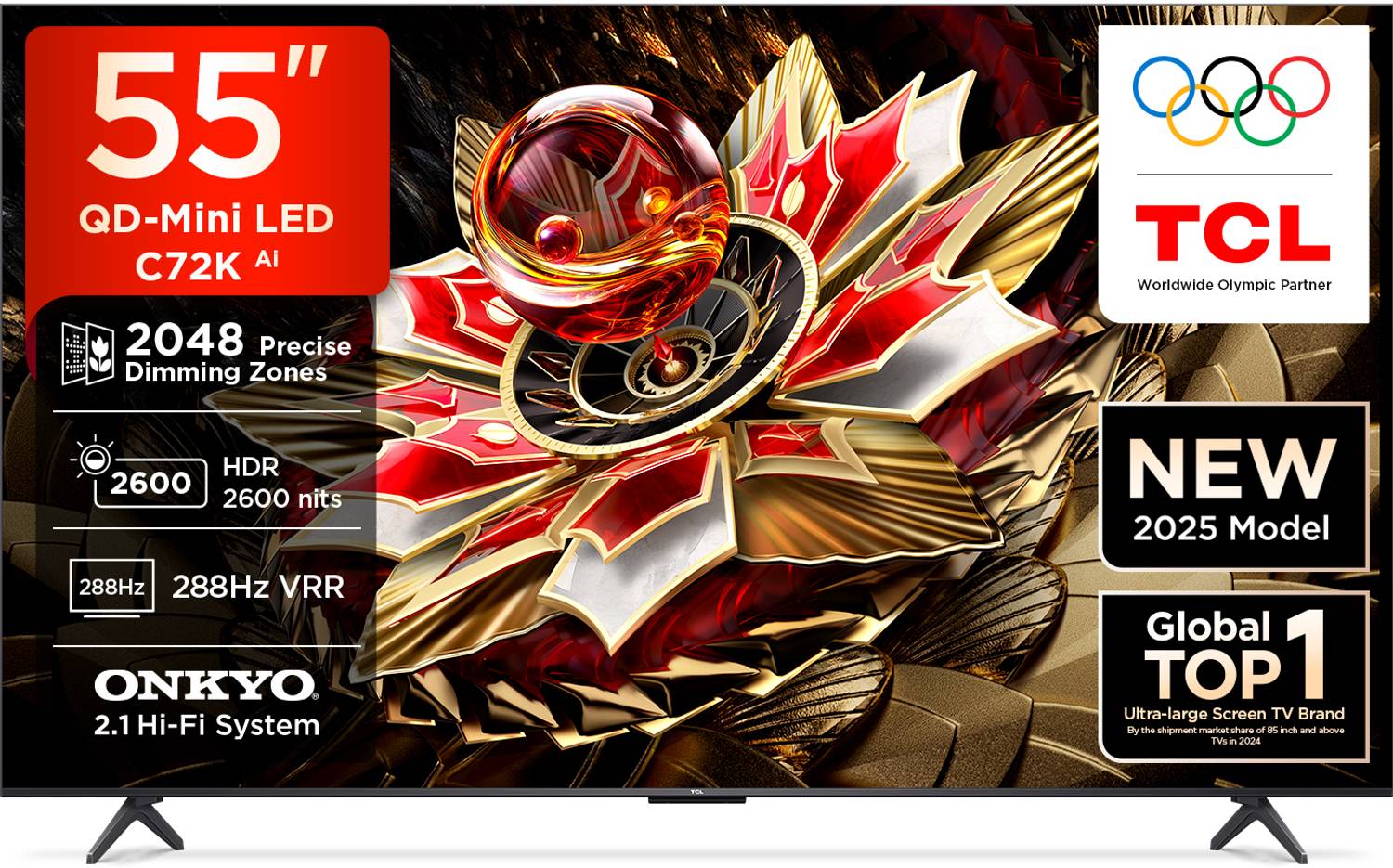
TCL 139 cm (55 inches) 4K UHD Smart QD-Mini LED Google TV 55C72K
Lowest price
Up to 5% off with Flipkart Axis & Flipkart SBI Credit Cards Details
- Up to 5% off with Flipkart Axis & Flipkart SBI Credit Cards
Pros and cons
What I like
+ Up to 2,048 zones and 2,600 nits claimed, very bright in daylight
+ Native 144 Hz with VRR and Dolby Vision gaming
+ 60W Onkyo 2.1.2 sound
+ 3GB / 64GB Google TV and 2-year warranty
What I don’t like
• Only two HDMI 2.1 ports; about 13 ms lag
• TCL service and delivery-damage complaints
• Brightness and zones are claims for this model
My full review: who it suits, what it is like and how it compares
Who should buy it. Someone who wants the most HDR brightness and contrast for the money in a 55 inch, watches in a room with windows and lamps, and lives in a city where TCL service is reachable. It is a 2025 model; the 2026 C7L exists but costs more. If brand service matters more than brightness, the Sony Bravia 5 is the safer choice.
Picture in a real living room. In a bright room the C7K simply cuts through: reviewers comparing it side by side with an LG C5 for six months found its HDR highlights far punchier in daylight. Dimming is tight for an LCD, though a bright object on a black background still shows a faint glow that OLED does not have. The quantum dot layer gives wide colour, with reviewers measuring about 97% of the P3 range on the global model. The HVA panel holds up reasonably from the side. Upscaling is good for 1080p content but struggles with very low resolution sources like old 480p channels.
Smart features and speed. It runs Google TV with 3GB RAM and 64GB storage, the most storage in this list, with hands-free voice control, Chromecast and AirPlay 2. All the Indian apps are there and the interface is generally smooth, though one owner found app-loading animations less fluid than on an older Sony. The remote is simple and light.
Gaming and PS5. The panel is native 144 Hz with VRR from 48 to 288 Hz in its DLG mode, ALLM, FreeSync Premium Pro and Dolby Vision gaming. Input lag on the global model was around 13 ms in one comparison, against roughly 1 to 5 ms on the LG C5, so fast shooters feel a little less snappy. HDR games look bright and dramatic. The same comparison found only two of the four HDMI ports are full HDMI 2.1, so keep them for the PS5 and a second console.
Build, ports and service. The design is slim with ports on the side for easy access, plus four HDMI, one USB, optical and Ethernet. The India 55C72K uses a 60W Onkyo 2.1.2 system with Dolby Atmos and DTS:X, which owners say is good enough to skip a soundbar for everyday viewing; the Bang and Olufsen system reviewers praised is on the global C7K. TCL gives 2 years warranty, but several buyers reported damaged units and repeated cancelled pickups, so inspect the panel at installation.
TCL C7K 55 or TCL Q6C / C6K 55? The C7K has far more claimed zones (up to 2,048 against 512+), higher claimed brightness, 64GB storage and 60W Onkyo 2.1.2 sound. The Q6C has measured brightness behind it and costs a lot less. Both are 144 Hz with two full HDMI 2.1 ports. Pick the C7K for HDR punch, the Q6C for value.
TCL C7K 55 or Samsung QN90F 65? The QN90F has measured brightness of about 2,086 nits, four HDMI 2.1 ports, Samsung service and a bigger screen. The C7K costs far less, adds Dolby Vision and 60W sound, and its figures are claims. If you want proof and service, the Samsung. If you want the most Mini LED for less, the TCL.
Key specs
| Screen | 55 inch 4K QD-Mini LED |
| Panel and backlight | HVA panel, full-array Mini LED, up to 2,048 dimming zones (claimed) |
| Refresh rate (native) | 144 Hz (VRR 48-288 Hz with DLG) |
| HDR | Dolby Vision IQ, HDR10+, HDR10, HLG |
| Brightness | 2,600 nits HDR (claimed) |
| Smart OS | Google TV |
| RAM / storage | 3GB / 64GB |
| Sound | 60W, Onkyo 2.1.2, Dolby Atmos, DTS:X |
| Ports | 4 HDMI (2 x HDMI 2.1 per global review), 1 USB, optical, Ethernet |
| Warranty | 2 years |
| Model code | 55C72K |
Best value
4. TCL Q6C 55 inch 4K QD-Mini LED Google TV (55Q6C, also sold as 55C6K)
8.6Geekman Score
8.5 Picture
8.8 Features
7.8 Service
9.0 Value
The best all-round Mini LED for the money: native 144 Hz, Dolby Vision IQ and about 700 to 1,000 nits measured, sold as Q6C or C6K.
Native 144 Hz · Dolby Vision IQ · 512+ zones claimed · Google TV
Best for
✓ Movie and OTT fans who want bright HDR with Dolby Vision IQ and good dimming at a mid price
✓ PS5 and PC gamers who want native 144 Hz, VRR and FreeSync Premium
✓ Buyers who want Google TV with 3 GB RAM and a 2-year warranty
Skip if
• You watch a lot of fast cricket or football (reviewers saw doubled balls and weak sports motion; a Sony handles motion better)
• Your budget stops at 50k (the Hisense U7Q 55 has four HDMI 2.1 ports and real dimming for less)
• You need more than two 4K 120 ports or more than one USB port
My take: This is the 55 inch Mini LED I’d recommend to most people who can stretch a little past 50k. Lab measurements show about 705 nits in Filmmaker mode and about 984 nits in Standard, with native 144 Hz, Dolby Vision IQ, HDR10+, 46W Onkyo sound and a 2-year warranty. The honest catches: one owner counted far fewer real zones on the 55 inch than the 512+ claim, sports motion is weak, the TV is slow to wake, and TCL service has mixed reports.

TCL 139 cm (55 Inches) SmartChoice 4K UHD Smart QD-Mini LED Google TV | 144Hz Refresh Rate | 3GB RAM | 46W Onkyo 2.1 | Upto 512+ Zones | IMAX Enhanced | 55Q6C
Up to 4% instant discount on select Credit Cards & SBI Debit Cards +1
- Up to 4% instant discount on select Credit Cards & SBI Debit Cards
- No Cost EMI on select cards
Lowest price
Up to 5% off with Flipkart Axis & Flipkart SBI Credit Cards Details
- Up to 5% off with Flipkart Axis & Flipkart SBI Credit Cards
Pros and cons
What I like
+ Native 144 Hz with VRR, FreeSync Premium and ALLM
+ Measured about 705 to 984 nits
+ Dolby Vision IQ, HDR10+, 46W Onkyo 2.1
+ 3 GB RAM, Google TV, 2-year warranty
What I don’t like
• Real zone count on the 55 inch looks far below 512+
• Weak motion in fast sports; slow wake-up
• Only two full HDMI 2.1 ports and one USB
My full review: who it suits, what it is like and how it compares
Who should buy it. Someone who wants one TV for Netflix nights, HDR films and PS5 games, and can spend a little above 50k. The same TV is sold under two names, Q6C and C6K, with identical specs. If you watch mostly live sports, or your budget is firm at 50k, look at the Hisense U7Q 55 or TCL T89C.
Picture in a real living room. The HVA panel with a quantum dot Mini LED backlight gives deep blacks and bright highlights. Lab measurements of this model (sold elsewhere as C6K) show about 705 nits in a 10% window in Filmmaker mode and about 984 nits in Standard mode, and an Indian reviewer saw about 800 nits. HDR and Dolby Vision content looks rich, Dolby Vision IQ adjusts to room light, and upscaling of older content is fine. The cons are real: some black crush in dark scenes, average viewing angles, and a reflective screen that shows lamps and windows. On the zone count, the box says 512+, but that figure suits the 75 inch; one owner counted about 128 zones on his 55 inch, so expect more blooming than the number suggests. Fast sports can show doubled balls.
Smart features and speed. Google TV runs on a quad-core chip with 3 GB RAM and 32 GB storage, and day to day it feels smooth. Two owner complaints come up: the TV takes 35 to 40 seconds to wake before the remote responds, and apps reload when you switch between them. It launched on Android TV 12, and owners reported an Android 14 update in late 2026. Hands-free voice, AirPlay and screen mirroring are built in. Wi-Fi is 5, not 6.
Gaming and PS5. The panel is native 144 Hz with VRR, ALLM and AMD FreeSync Premium. A PS5 runs 4K 120 with VRR working, and a PC can push 4K 144. Lab measurements put input lag at about 13.6 ms. Of the four HDMI ports, only two support full 4K 144 bandwidth, so plan which ports the console and soundbar use.
Build, ports and service. Slim bezels on three sides and a sturdy plastic back with cable clips. The 46W Onkyo 2.1 system with a subwoofer, Dolby Atmos and DTS Virtual:X is clear and punchy enough to skip a soundbar for daily use. There is only one USB port. Warranty is 2 years on-site. Service is the risk: one owner waited over a month for installation, and one buyer reported a failure within two months, so buy from a seller with easy returns and check TCL coverage in your town.
TCL Q6C / C6K 55 or Xiaomi S Mini LED 55? The TCL runs native 144 Hz with VRR and has measured about 705 to 984 nits, 3 GB RAM and a 2 year on-site warranty. The Xiaomi has 308 published zones and similar HDR brightness (about 977 nits), but a 60 Hz panel and 2 GB RAM. For gaming and smooth software, the TCL. For movies and cricket in daylight, the Xiaomi is a close match.
Key specs
| Screen | 55 inch 4K (3840 x 2160) |
| Panel and backlight | HVA panel, QD Mini LED, 512+ zones claimed (an owner counted about 128 on the 55 inch) |
| Refresh rate (native) | 144 Hz, VRR, ALLM, FreeSync Premium |
| HDR | Dolby Vision IQ, HDR10+, HDR10, HLG, IMAX Enhanced |
| Brightness | About 705 nits (Filmmaker) to 984 nits (Standard) measured |
| Smart OS | Google TV |
| RAM / storage | 3 GB / 32 GB |
| Sound | 46W Onkyo 2.1 with subwoofer, Dolby Atmos, DTS Virtual:X |
| Ports (HDMI incl. 2.1/eARC, USB) | 4 HDMI (2 with full HDMI 2.1 4K 144, one eARC), 1 USB, optical, LAN, satellite |
| Warranty | 2 years on-site |
| Model code | 55Q6C (twin: 55C6K) |
Best for bright rooms on a budget
5. Xiaomi TV S Mini LED 55 inch 2026 (L55MC-IN)
8.3Geekman Score
8.3 Picture
7.4 Features
8.0 Service
9.6 Value
The brightest picture in the 55 inch Mini LED crowd at its price, with 308 published zones, held back by a 60 Hz panel and 2 GB RAM.
308 zones · Dolby Vision · 60 Hz panel · Google TV
Best for
✓ A bright living room with big windows where most TVs look washed out in the afternoon
✓ Netflix, Prime Video and JioHotstar watchers who want Dolby Vision and HDR10+ with deep night-time blacks
✓ Families who watch from straight in front of the TV and want room-filling sound without a soundbar on day one
Skip if
• You own a PS5 and want 4K 120 games (the panel is 60 Hz; the TCL Q6C or Hisense E8S have native 144 Hz)
• Your sofa wraps around the TV and people watch from the sides (the VA panel washes out off-angle)
• You hate any lag in menus (2 GB RAM; the Lumio Vision 9 is much faster)
My take: If picture is what you care about and you don’t game at 120 fps, this is the 55 inch I’d pick around this money. Reviewers measured the 55 inch at about 977 nits in HDR, it has 308 real dimming zones, and side by side it was brighter and punchier than the Lumio Vision 9 and less bloomy than the Sony Bravia 2 II. The catches are a 60 Hz panel sold with “120 Hz DLG” on the box, 2 GB RAM that lags now and then, and only one HDMI 2.1 port.
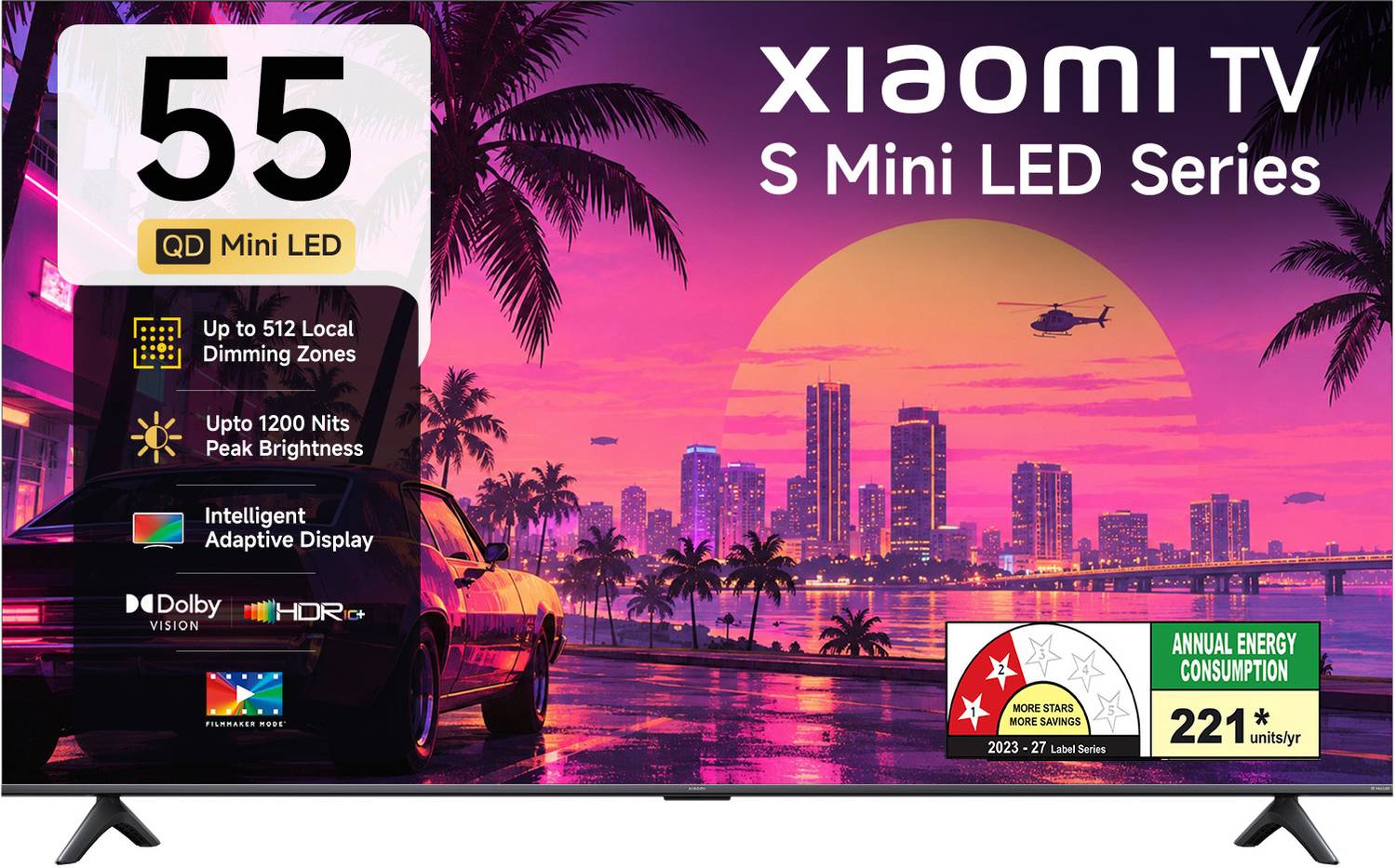
Xiaomi (139 cm) 55 inch S 4K QD-Mini LED | Dolby Vision| Upto 512 Dimming Zones | 34W Speakers | 120Hz DLG | Gemini AI | Google TV | L55MC-IN
Lowest price
Up to 5% off with Flipkart Axis & Flipkart SBI Credit Cards Details
- Up to 5% off with Flipkart Axis & Flipkart SBI Credit Cards
Pros and cons
What I like
+ 308/384/512 real dimming zones published by size
+ Bright: measured about 977 nits HDR on the 55 inch
+ Deep blacks at night with low blooming
+ Dolby Vision, HDR10+ and 34W quad speakers
What I don’t like
• 60 Hz panel; “120 Hz” is DLG at lower resolution
• 2 GB RAM brings occasional lag
• Narrow viewing angles and only one HDMI 2.1 port
My full review: who it suits, what it is like and how it compares
Who should buy it. A family that watches OTT shows, movies and cricket in a bright hall and wants a big step up in contrast from a regular LED or QLED. It suits buyers who sit roughly in front of the screen at 7 to 9 feet. If gaming at 120 fps or a lag-free interface matters more than raw picture, the Lumio Vision 9 or Hisense U7Q make more sense.
Picture in a real living room. This is a VA panel with a quantum dot Mini LED backlight and 308 dimming zones on the 55 inch (the ‘up to 512’ line on the box applies only to the 75 inch). Reviewers measured the 55 inch at about 492 nits in SDR and 977 nits in HDR, and with the windows open in daylight the picture stayed bright and clear. At night a full black screen looked almost switched off, and blooming around bright objects was lower than on the Sony Bravia 2 II. SDR colours are rich out of the box; in HDR they look slightly under-saturated, and raising saturation by about 10% fixes that. Detail is sharp, and upscaling of older TV content came close to Sony. The weak point is viewing angle: from the side of the sofa colours fade by a noticeable amount.
Smart features and speed. It runs Google TV on Android 14 with Xiaomi’s PatchWall and over 200 free live channels, so every major app is there and sideloading works. The hardware is the limit: a Cortex-A55 chip with 2 GB RAM. Owners and reviewers describe it as fine most of the time, with small lags when switching heavy apps, occasional jittery navigation, and the launcher sometimes restarting when you move between Google TV and PatchWall. Storage is 32 GB. The Bluetooth remote has number keys, voice and quick settings. Over a few years, 2 GB RAM is the part most likely to annoy you; a streaming stick is the cheap fix.
Sound. Four speakers (two tweeters and two full-range drivers) give 34W with Dolby Audio and DTS:X. Reviewers found it comfortably loud for a 200 sq ft room, with clear dialogue, a bit of bass and no distortion. One lab review found the bass thin on the 75 inch. The eARC port passes Dolby Atmos to a soundbar according to the brand’s spec, though one reviewer reported no Atmos passthrough on their unit, so test it early if you plan an Atmos bar.
Gaming and PS5. The panel is native 60 Hz. The “120 Hz” on the box is DLG (dual line gate), which gives 120 fps only at lower resolution, and there is no full VRR. ALLM is supported. For 4K 60 console games it is fine, but it is the wrong TV if you want PS5 games at 4K 120. Only one of the three HDMI ports is HDMI 2.1, and that port is also the eARC port, so a soundbar and a console end up sharing the good port.
Xiaomi S Mini LED 55 or Lumio Vision 9 2026? The Xiaomi is much brighter in SDR, with 308 zones against about 128 on the Lumio and better shadow detail. The Lumio has native 144 Hz, about 9.7 ms lag, 3 GB RAM and the fastest UI in this group. Bright room and movies, the Xiaomi. Dim room and gaming, the Lumio.
Key specs
| Screen | 55 inch 4K (3840 x 2160) |
| Panel and backlight | VA panel, QD Mini LED, 308 local dimming zones |
| Refresh rate (native) | 60 Hz (DLG 120 Hz at lower resolution, MEMC) |
| HDR | Dolby Vision, HDR10+, HDR10, HLG |
| Brightness | 1,200 nits claimed; 55 inch measured about 977 nits HDR, 492 nits SDR |
| Smart OS | Google TV (Android 14) with PatchWall |
| RAM / storage | 2 GB / 32 GB |
| Sound | 34W, 4 speakers, Dolby Audio, DTS:X |
| Ports (HDMI incl. 2.1/eARC, USB) | 3 HDMI (1 HDMI 2.1 with eARC), 2 USB 2.0, optical, 3.5 mm, LAN |
| Warranty | 1 year + 1 year on panel; extended offers vary |
| Model code | L55MC-IN |
Cheapest real Mini LED
6. Hisense U7Q 55 inch 4K QD Mini LED VIDAA TV (55U7Q)
8.2Geekman Score
8.1 Picture
8.6 Features
7.8 Service
8.5 Value
The cheapest TV here with a full gaming kit and real local dimming: native 144 Hz and four HDMI 2.1 ports, on VIDAA instead of Google TV.
Native 144 Hz · 4x HDMI 2.1 · Dolby Vision IQ · VIDAA
Best for
✓ PS5 or Xbox Series X owners who want 4K 120 on every HDMI port without paying Mini LED premium prices
✓ Movie watchers who stream a lot of Dolby Vision and HDR10+ content and watch mostly in the evening
✓ Buyers who mainly use Netflix, Prime Video and JioHotstar and don’t sideload apps
Skip if
• You play movies from a pen drive through VLC or use Spotify on the TV (VIDAA lacks both; the Lumio Vision 9 or TCL Q6C run Google TV)
• Your hall gets strong afternoon sun and you want the brightest picture (the Xiaomi S Mini LED 55 is clearly brighter)
• You watch a lot of live cricket and notice motion artefacts easily (the TCL T89C or a Sony handle that better)
My take: This is the TV I’d point most gamers to when the budget tops out around 50k. Native 144 Hz, four HDMI 2.1 ports, VRR with FreeSync Premium, ALLM, Dolby Vision IQ and HDR10+ Adaptive are all here, and lab measurements on the 65 inch show deep 0.11 nit blacks. The catch is the software and the punch: VIDAA has app gaps, the picture is softer and less bright than the TCL Q6C, and colours lean warm out of the box.
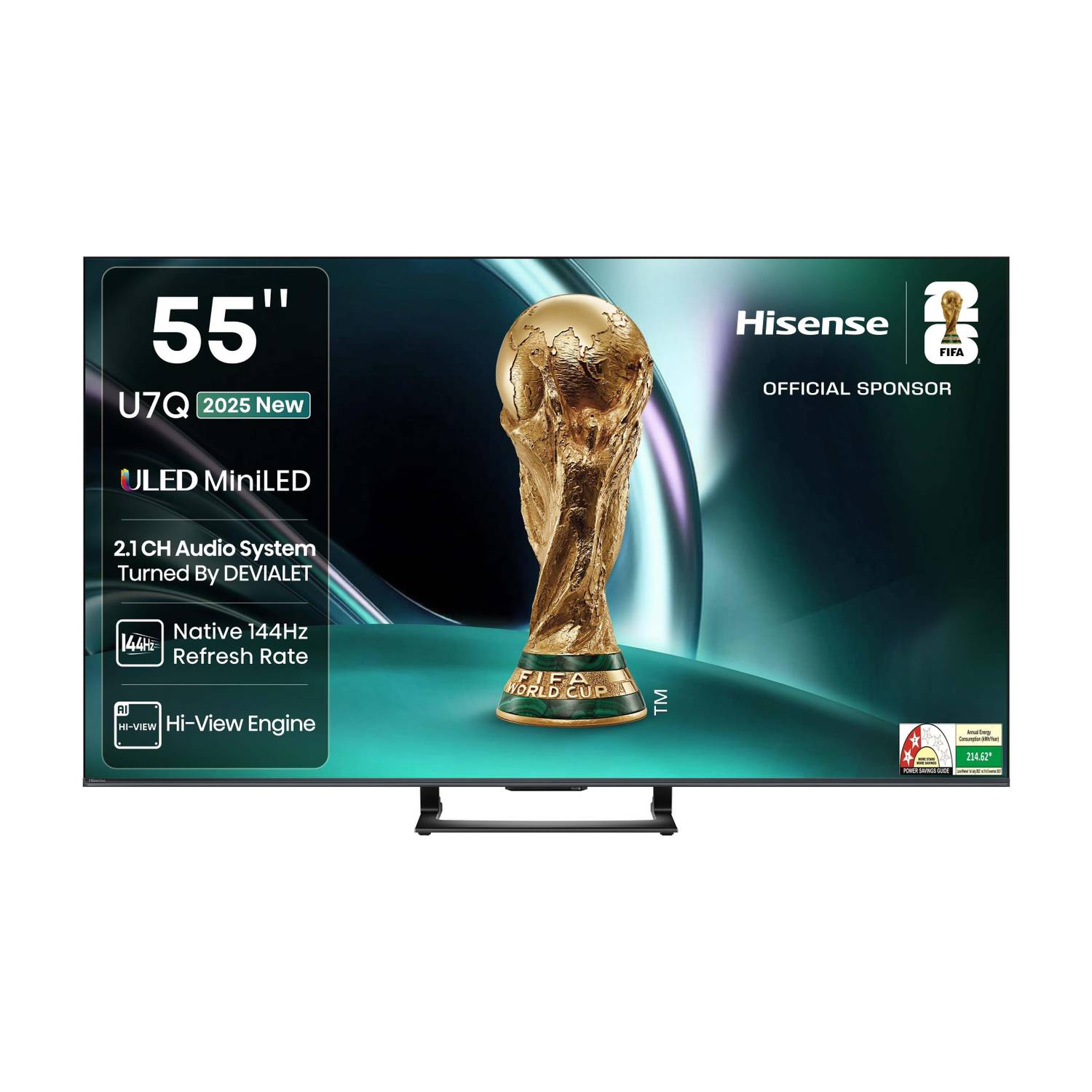
Hisense 55U7Q 138.5 cm (55 inch) Ultra HD (4K) Mini LED Smart VIDAA TV with 2.1CH Audio System Tuned by DEVALET, Native 144 Refresh Rate, Dolby Vision Atmos
Up to 5% off with Flipkart Axis & Flipkart SBI Credit Cards Details
- Up to 5% off with Flipkart Axis & Flipkart SBI Credit Cards
Pros and cons
What I like
+ Native 144 Hz with four HDMI 2.1 ports
+ Deep measured blacks (0.11 nit) and good blooming control
+ Dolby Vision IQ plus HDR10+ Adaptive
+ 49W 2.1 sound with a built-in subwoofer
What I don’t like
• VIDAA lacks VLC, Spotify and many apps
• Dimmer and softer than the TCL Q6C and Xiaomi S
• Warm colours and some motion artefacts in cricket
My full review: who it suits, what it is like and how it compares
Who should buy it. Someone who wants a real Mini LED backlight and proper PS5 support for under the price of most 144 Hz rivals. You plug the console, a set-top box and a streaming stick into any of the four HDMI ports and every one of them carries 4K 120. If your life on the TV is Netflix, Prime Video and other OTT apps from the store, VIDAA will not hold you back. If you rely on VLC, Spotify or sideloaded apps, a Google TV set like the Lumio Vision 9 or TCL Q6C is the easier life.
Picture in a real living room. Lab measurements on the 65 inch model show about 620 nits peak in a 25% window and a 0.11 nit black level, with about 94% of the UHDA-P3 colour range. In plain terms, blacks at night are deep and blooming around subtitles is well controlled, but HDR highlights don’t hit as hard as on the TCL Q6C or Xiaomi S. Out of the box the colours look a little warm and washed, so switch out of the energy saving preset and try the Theatre or Filmmaker modes. SD channels and low bitrate online video are upscaled only modestly, and fast cricket showed some motion artefacts. The screen is also quite reflective, so keep it away from a window directly opposite.
Smart features and speed. VIDAA is quick to boot and quick to move around, and the main OTT apps are there. The gaps are real, though: no VLC and no Spotify, and the app store is much smaller than Google TV’s. Voice control works hands-free, and the remote has hotkeys for the big streaming apps, but the remote design is dated. If you want Google TV apps later, a cheap streaming stick in one of the HDMI ports fixes most of this.
Gaming and PS5. This is its strongest area. The panel is native 144 Hz, all four HDMI ports are 2.1, and it supports VRR, FreeSync Premium and ALLM, so a PS5 switches into game mode on its own and runs 4K 120 games smoothly. Dolby Vision gaming and a game bar with frame rate readout are included. A PC can use the full 144 Hz. No rival here gives four full HDMI 2.1 ports for less.
Build, ports and service. The 55 inch has a 49W 2.1 system with a built-in subwoofer, tuned by Devialet, which is fuller than most TV speakers at this price; a soundbar is optional for normal TV use. The power cable is detachable, so a damaged cord is a cheap fix. Warranty on the 55 inch is 2 years. Hisense service in India runs through its own network and partners, and complaints do appear, so check coverage for your pin code before ordering. Stock of the 55 inch was running low at the time of writing.
Hisense U7Q 55 or Hisense E8S 55? The U7Q has four HDMI 2.1 ports against two on the E8S, and a 2 year warranty against one. The E8S is the newer 2026 model with louder 61W sound and JioHotstar in its VIDAA app store. For gaming on more than one device, the U7Q. For sound in a living room, the E8S.
Key specs
| Screen | 55 inch 4K (3840 x 2160) |
| Panel and backlight | QD-Mini LED, full-array local dimming (zone count not published) |
| Refresh rate (native) | 144 Hz, VRR with FreeSync Premium, ALLM |
| HDR | Dolby Vision IQ, HDR10+ Adaptive, HDR10, HLG |
| Brightness | About 620 nits peak measured on the 65 inch |
| Smart OS | VIDAA |
| RAM / storage | Not stated |
| Sound | 49W 2.1 with built-in subwoofer, Devialet tuned, Dolby Atmos |
| Ports (HDMI incl. 2.1/eARC, USB) | 4 HDMI, all HDMI 2.1, one with eARC; USB |
| Warranty | 2 years |
| Model code | 55U7Q |
Fastest smart TV with real zones
7. Lumio Vision 9 (2026) 55 inch 4K Mini LED Google TV (EPIC3-ADSI)
8.1Geekman Score
7.7 Picture
8.7 Features
6.6 Service
9.6 Value
The fastest, smoothest Google TV here with native 144 Hz and 9.7 ms input lag, best in a dim room; check the model code is EPIC3-ADSI.
Native 144 Hz · 9.7 ms input lag · 3 GB RAM · Google TV
Best for
✓ PC and console gamers who want native 4K 144 Hz, 1080p 240 Hz and very low input lag
✓ People fed up with laggy TVs: 3 GB RAM, 64 GB storage and quick app switching
✓ Evening and night viewers in a room without strong daylight
Skip if
• Your hall is bright in the daytime (it dims noticeably; the Xiaomi S Mini LED 55 is much brighter with 308 zones)
• You watch a lot on JioHotstar (a lab review found it unsupported at the time; check before you buy)
• You live in a small town without a Lumio service centre nearby (the Hisense U7Q or TCL Q6C have wider networks)
My take: I’d buy this one for speed and gaming. The Pentonic 700 chip with 3 GB RAM makes it the quickest Google TV in this group, apps stay in memory, and the native 144 Hz panel with 9.7 ms input lag suits a PS5 or gaming PC. The catch is brightness and dimming: lab measurements show only about 451 nits, it has about 128 zones, and local dimming switches off on console inputs. Make sure you get the 2026 EPIC3-ADSI and not the older 60 Hz EPIC1-ADSG sold under the same name.
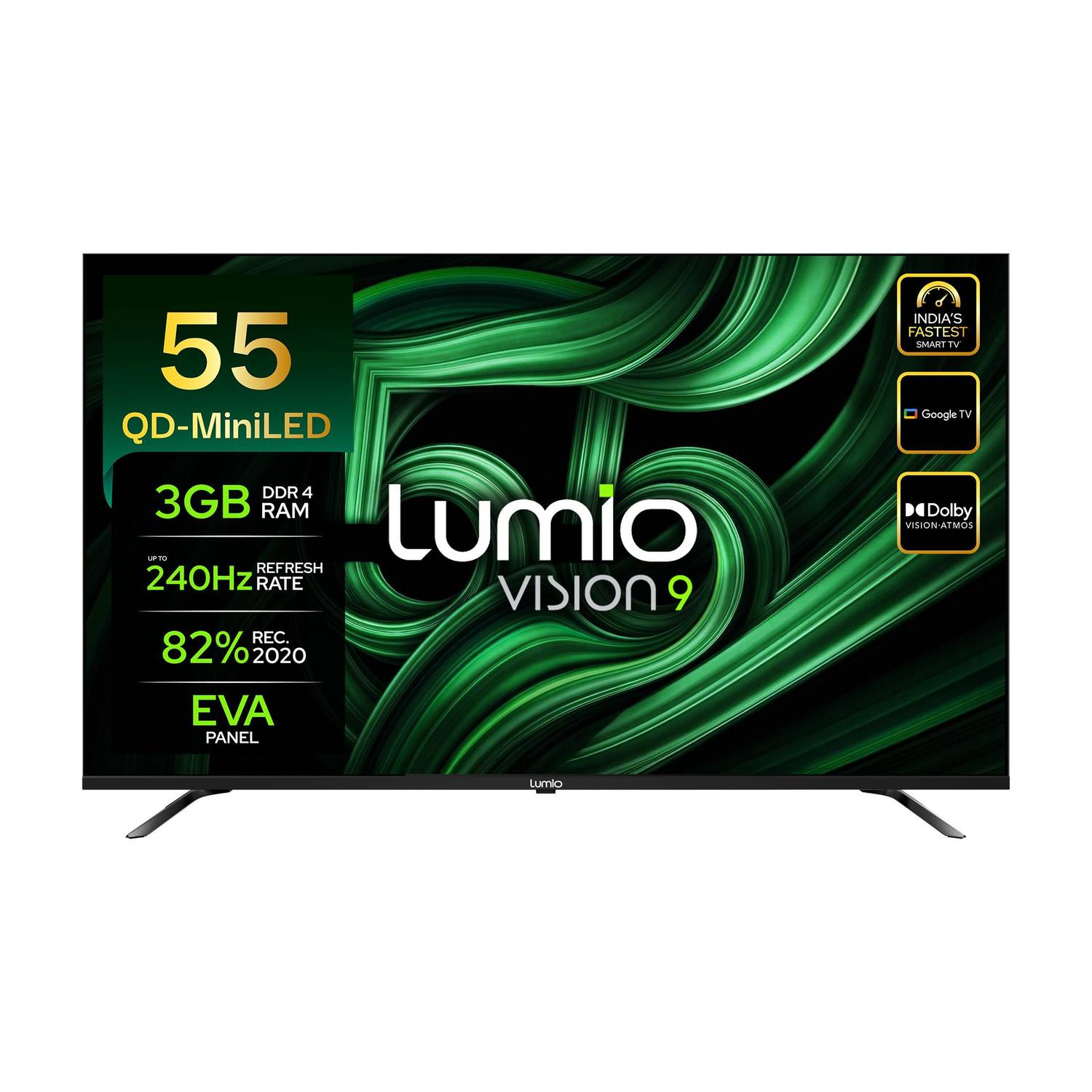
Lumio Vision 9 139 cm (55 inch) Ultra HD (4K) Mini LED Smart Google TV 2026 Edition with 4K 144Hz 1080p 240Hz HDR Dolby Vision + Atmos and 800 Nits Peak Brightness Over 100% Colour India's Fastest Smart TV* with 3GB RAM
Up to 5% off with Flipkart Axis & Flipkart SBI Credit Cards Details
- Up to 5% off with Flipkart Axis & Flipkart SBI Credit Cards
Pros and cons
What I like
+ Fastest UI here: Pentonic 700, 3 GB RAM, 64 GB
+ Native 144 Hz, 1080p 240 Hz, about 9.7 ms input lag
+ Deep blacks in a dim room, natural colours
+ USB 3.0, satellite input and 2-year warranty
What I don’t like
• Only about 451 nits measured; dim in daylight
• About 128 zones; shadow crush and dimming off on consoles
• JioHotstar not supported per a lab review
My full review: who it suits, what it is like and how it compares
Who should buy it. A gamer or a heavy app user who watches mostly in the evening and wants the snappiest smart TV around this money. It also suits Free Dish users, because the satellite input takes the dish cable directly without a set-top box. The Vision 9 name covers two different TVs: the 2026 EPIC3-ADSI with 144 Hz, and the 2025 EPIC1-ADSG with a 60 Hz panel that still sells at about the same price. Check the model code on the product page and the box.
Picture in a real living room. Blacks are the strength: in a dim room dark scenes look properly deep with no grey wash or edge bleed, and lab measurements show a black level near 0.03 nit. Colours are tuned natural, skin tones look real, and Dolby Vision goes slightly warm. Noise reduction and upscaling of old films, news and serials are handled well. The weaknesses show in daylight and in very dark films. Lab measurements put typical brightness at about 451 nits against an 800 nit claim, so with windows open it looks dim next to the Xiaomi S. Shadow detail gets crushed in very dark scenes, HDR is inconsistent in those scenes, and with about 128 zones you see more glow around subtitles and bright objects than on the Xiaomi. One reviewer also saw faint patches on solid colour test screens, though not in real content.
Smart features and speed. This is the fastest TV in the group. Google TV runs on a MediaTek Pentonic 700 with 3 GB DDR4 RAM and 64 GB storage, boots quickly, and keeps three or four apps in memory so Netflix, Prime Video and other apps resume where you left them. The small Minion 2 remote has hotkeys and Google Assistant. One lab review found JioHotstar unsupported and parts of Lumio’s own Project Neo features unfinished, so confirm the apps you need before buying.
Gaming and PS5. The panel is native 4K 144 Hz, and a PC can run 1080p at 240 Hz. HDMI 2.1, VRR and ALLM are supported, and measured input lag is about 9.7 ms, the lowest among the mid-range TVs in this list. Two things to know: local dimming turns off on console inputs, and game colours looked a bit dull until tuned, so PS5 HDR needs some manual setup. One review counts three HDMI 2.1 ports on the 55 inch; a lab review counts two of three at full bandwidth.
Build, ports and service. The metal build has thin bezels on three sides, but the bottom strip is thick with a small gap, and it feels less refined than the Xiaomi or TCL. The 55 inch has 24W from four speakers: loud with real bass up to about 60% volume, then it distorts. Ports include three HDMI, two USB 2.0 plus a USB 3.0, optical, LAN, 3.5 mm and a satellite input. The 2-year comprehensive warranty is generous. Lumio is a young brand with about 300 service centres covering a large pin code list, still smaller than Xiaomi, TCL or Samsung, so check your area.
Lumio Vision 9 2026 or Hisense U7Q 55? The Lumio runs Google TV with 3 GB RAM and 64GB storage, about 9.7 ms lag and 144 Hz. The Hisense has four HDMI 2.1 ports and more brightness (about 620 nits measured against about 451), but VIDAA misses some apps. The Lumio turns local dimming off on console inputs and lacks JioHotstar per one review, so for gaming picture the Hisense is better.
Key specs
| Screen | 55 inch 4K (3840 x 2160) |
| Panel and backlight | Enhanced VA panel, QD Mini LED, about 128 dimming zones |
| Refresh rate (native) | 144 Hz (1080p 240 Hz), VRR, ALLM |
| HDR | Dolby Vision, HDR10, HLG |
| Brightness | 800 nits claimed; about 451 nits typical measured on the 65 inch |
| Smart OS | Google TV (Android 14) |
| RAM / storage | 3 GB / 64 GB |
| Sound | 24W, 4 speakers, Dolby |
| Ports (HDMI incl. 2.1/eARC, USB) | 3 HDMI 2.1 class (2 full bandwidth per lab review), 2 USB 2.0 + 1 USB 3.0, optical, LAN, satellite |
| Warranty | 2 years comprehensive |
| Model code | EPIC3-ADSI (2026) |
Best sound
8. Hisense E8S 55 inch 4K Mini LED VIDAA TV (55E8S)
8.0Geekman Score
7.8 Picture
8.3 Features
7.5 Service
8.6 Value
A 2026 Mini LED with native 144 Hz and the loudest built-in sound here (61W with a subwoofer), on VIDAA, for buyers who want gaming and audio in one box.
Native 144 Hz · 61W with subwoofer · Dolby Vision IQ · VIDAA
Best for
✓ PS5 owners who want 4K 120 with Dolby Vision gaming at a 55 inch price
✓ Families who want strong TV speakers with real bass and no soundbar
✓ Viewers who like natural, accurate colours more than a showroom look
Skip if
• Your room is very bright and you want maximum HDR punch (the Xiaomi S Mini LED 55 is brighter)
• You need VLC, Spotify or sideloaded apps (VIDAA has a smaller app store; Google TV sets like the TCL Q6C avoid this)
• You plan to connect a soundbar and two consoles (only two HDMI ports are 2.1, and one of them is the eARC port)
My take: I’d pick the E8S when you want a 2026 Mini LED that does gaming and sound well without a soundbar. The panel is native 144 Hz, it supports VRR, ALLM and FreeSync Premium, and the 61W Devialet-tuned system with a built-in subwoofer is loud without distortion. At 55 inches it costs a little more than the Hisense U7Q, which has four HDMI 2.1 ports. Hisense does not publish the zone count, and reviewers found it well-rounded rather than bright.
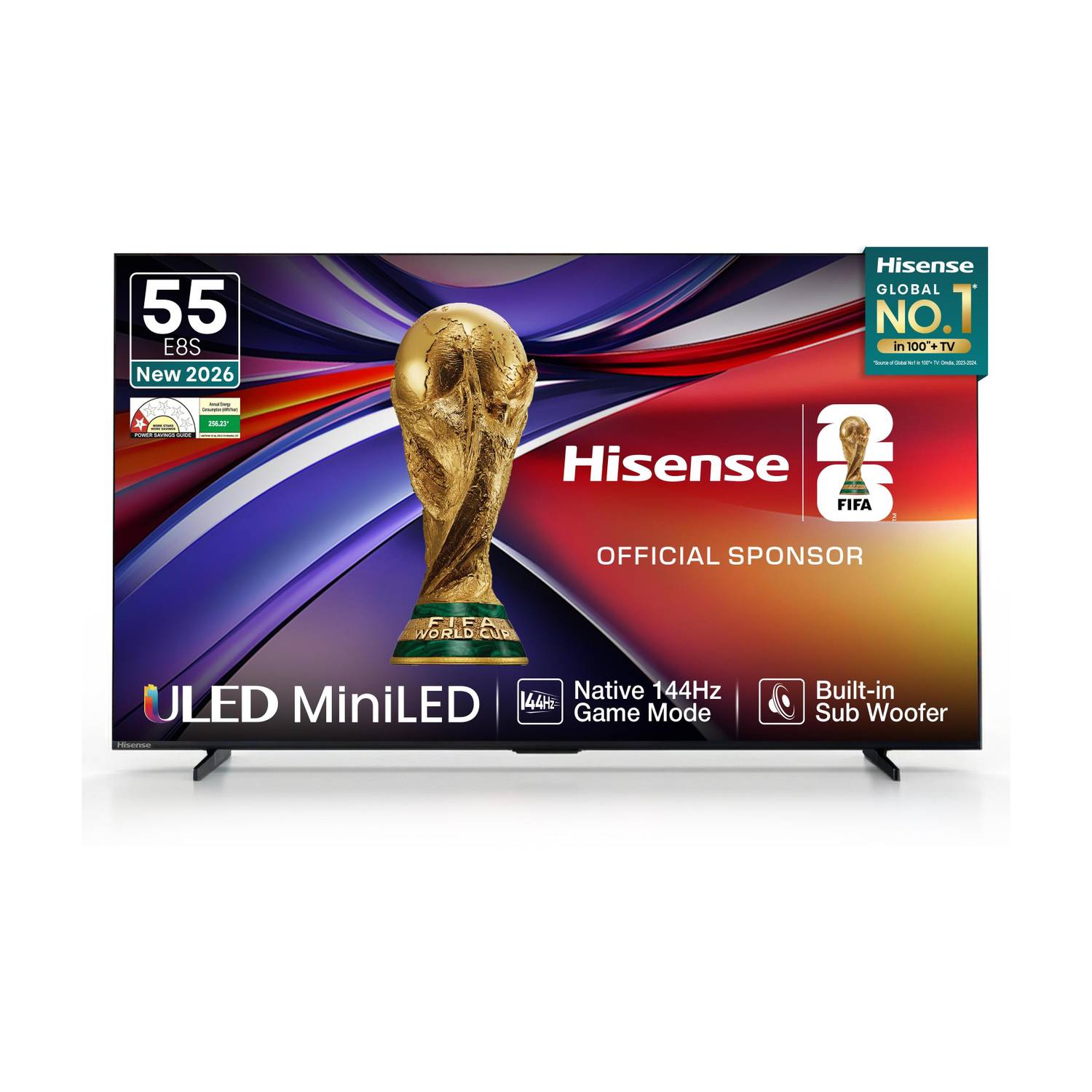
Hisense 55 Inch 55E8S Hi-QLED MiniLED Smart TV | 144Hz Game Mode | Devialet Sound and AI Picture | Dolby Vision IQ | Hands-Free Voice
Lowest price
Up to 5% off with Flipkart Axis & Flipkart SBI Credit Cards Details
- Up to 5% off with Flipkart Axis & Flipkart SBI Credit Cards
Pros and cons
What I like
+ Native 144 Hz with VRR, ALLM and FreeSync Premium
+ 61W Devialet sound with a built-in subwoofer
+ Natural colours and steady brightness
+ Fast VIDAA with JioHotstar and free channels
What I don’t like
• Zone count not published; not the brightest Mini LED
• Only two HDMI 2.1 ports, one shared with eARC
• VIDAA app store is smaller than Google TV’s
My full review: who it suits, what it is like and how it compares
Who should buy it. A buyer who wants PS5 gaming at 4K 120, good sound out of the box and a picture that is accurate rather than loud. It suits a normal Indian living room watched mostly in the evening. If you need four HDMI 2.1 ports and lab-measured contrast, the Hisense U7Q 55 costs a little less and has them.
Picture in a real living room. On an 85 inch sibling, a reviewer measured about 550 nits in a 10% window and about 400 nits full screen, holding steady without dimming, plus around 8,000:1 native contrast and 89% DCI-P3 in SDR. Hisense claims 500 nits typical and up to 700 peak in India. Blacks are rich in a dark room and the panel is uniform, with only slight darkening at the corners. Blooming is present but well cleaned up, and gets worse from the side; the picture holds up to about 50 degrees off-centre. Colours are Pantone-validated and natural. One Indian reviewer found HDR colours a little dull for Indian tastes out of the box, so expect to adjust saturation or try Dolby Vision Custom. The semi-matte screen cuts reflections better than a glossy one but is not fully matte.
Smart features and speed. VIDAA sets up in minutes through a phone app and is fast: Netflix starts playing quickly and the interface moves without lag. You get Netflix, Prime Video, JioHotstar, Zee5, SonyLIV and a lot of free live channels, plus continue-watching rows pulled from the apps. Alexa and Google Home can control the TV, and VIDAA Voice works hands-free. The weak side is the smaller app store compared with Google TV, and one reviewer found the remote’s pause key did nothing in an app, so OK had to do the job. Storage is 16 GB; Hisense does not state the RAM.
Gaming and PS5. The panel is native 144 Hz with VRR, ALLM and AMD FreeSync Premium. A PS5 runs 4K 120 games smoothly, and a PC can use 144 Hz. Reviewers saw no major ghosting. Of the four HDMI ports, two are HDMI 2.1 and two are 4K 60 HDMI 2.0, and the eARC port is one of the 2.1 pair. Connect a soundbar there and you are left with one full-speed port for a console.
Build, ports and service. Sound is where the E8S stands apart. The 61W system has a built-in subwoofer and Devialet tuning, and reviewers found it loud and punchy with very little distortion at high volume, so for news, serials and most movies you can skip the soundbar. The stand feet feel sturdy and alloy-like, the power cord is detachable, and the bezels are thin. Ports are 4 HDMI, 2 USB 2.0, LAN, optical, antenna and satellite. The 55 inch weighs about 13.7 kg without the stand. Warranty is 1 year comprehensive. One owner reported slow after-sales service on a remote replacement within warranty, so check Hisense service near you.
Hisense E8S 55 or TCL Q6C / C6K 55? The E8S has the loudest sound here, 61W with a built-in sub, and native 144 Hz. The Q6C is brighter, runs Google TV and has a 2 year warranty against the Hisense’s one. Both have two HDMI 2.1 ports. If you will not buy a soundbar, the Hisense. Otherwise the TCL is the better TV.
Key specs
| Screen | 55 inch 4K (3840 x 2160) |
| Panel and backlight | Hi-QLED Mini LED, full-array local dimming (zones not published), 8,500:1 native contrast claimed |
| Refresh rate (native) | 144 Hz, VRR, ALLM, FreeSync Premium |
| HDR | Dolby Vision IQ, HDR10+ Adaptive, HDR10, HLG |
| Brightness | 500 nits typical / 700 peak claimed; about 550 nits measured on an 85 inch sibling |
| Smart OS | VIDAA |
| RAM / storage | RAM not stated / 16 GB |
| Sound | 61W with built-in subwoofer, Devialet tuned, Dolby Atmos |
| Ports (HDMI incl. 2.1/eARC, USB) | 4 HDMI (2 HDMI 2.1, one with eARC; 2 HDMI 2.0), 2 USB 2.0, optical, LAN |
| Warranty | 1 year comprehensive |
| Model code | 55E8S |
“Mini LED” TVs I would skip (and why)
Each of these is sold as Mini LED. Most lack the one thing Mini LED is for, which is real local dimming.
Samsung “Mini LED” M2, M70H and M80H. They have the Mini LED name but no hardware local dimming, so blacks look like any LED TV. The HDMI ports top out at 4K 60.
LG QNED82. Brand-safe on paper, with 120 Hz and LG service, but the only India review I found showed an IPS panel without full-array dimming. Without zones, it is not a real Mini LED pick.
Samsung QN70H. Edge-lit with a 60 Hz panel, so it cannot dim in zones the way a full-array Mini LED does.
Xiaomi FX Mini LED. No published zone count and a 60 Hz panel that reaches “120 Hz” only with DLG. The Xiaomi S is the one to buy.
LG QNED65. A 60 Hz panel and only about 300 nits, which is too dim for HDR to look like HDR.
Lumio Vision 9 (2025, EPIC1-ADSG). Sold at close to the 2026 model’s price but with a 60 Hz panel, fewer zones and 24W sound. Buy only the EPIC3-ADSI.
Vu Glo, Coocaa MINI75Q and Philips MLED610. “120 Hz” through HSR and no published zone counts. Too little proof of real dimming.
Compare all 8 at a glance
| TV | Size | Panel | Native refresh | HDR | OS | Sound | Warranty |
|---|---|---|---|---|---|---|---|
| Sony Bravia 5 55 | 55″ 4K | Mini LED (full array, zones not stated) | 120 Hz / 2x HDMI 2.1 | Dolby Vision | Google TV · 3GB | 40W 2.0 | 2 years (current offer) |
| Samsung QN90F 65 | 65″ 4K | Mini LED (full array, zones not stated) | 165 Hz / 4x HDMI 2.1 | HDR10+ | Tizen · not stated | 60W 4.2.2 | 1 year + 1 year panel |
| TCL C7K 55 | 55″ 4K | QD-Mini LED (2,048 zones) | 144 Hz / 2x HDMI 2.1 | Dolby Vision, HDR10+ | Google TV · 3GB | 60W 2.1.2 | 2 years |
| TCL Q6C / C6K 55 | 55″ 4K | QD-Mini LED (full array, 512+ zones claimed (one count about 128)) | 144 Hz / 2x HDMI 2.1 | Dolby Vision, HDR10+ | Google TV · 3GB | 46W 2.1 with sub | 2 years |
| Xiaomi S Mini LED 55 | 55″ 4K | QD-Mini LED (308 zones) | 60 Hz | Dolby Vision, HDR10+ | Google TV · 2GB | 34W, 4 speakers | 1 year + 1 year panel (offers |
| Hisense U7Q 55 | 55″ 4K | QD-Mini LED (full array, zones not stated) | 144 Hz / 4x HDMI 2.1 | Dolby Vision, HDR10+ | VIDAA · not stated | 49W 2.1 with sub | 2 years |
| Lumio Vision 9 2026 | 55″ 4K | QD-Mini LED (128 zones) | 144 Hz / 2x HDMI 2.1 | Dolby Vision | Google TV · 3GB | 24W, 4 speakers | 2 years |
| Hisense E8S 55 | 55″ 4K | QD-Mini LED (full array, zones not stated) | 144 Hz / 2x HDMI 2.1 | Dolby Vision, HDR10+ | VIDAA · not stated | 61W 2.1 with sub | 1 year |
Native refresh is what the panel really runs at. Many budget TVs print “120 Hz” on the box using motion smoothing on a 60 Hz panel, so trust this column, not the title.
The buying guide
How to choose a Mini LED TV
Look for a zone count
Xiaomi publishes 308 zones on the 55 inch S. If a brand gives no zone count and no dimming setting, assume the dimming is weak or missing.
Native Hz, not DLG
The Xiaomi S reaches “120 Hz” only with DLG at lower resolution. The TCL, Hisense and Lumio picks here run 144 Hz natively.
Check the model code
Lumio Vision 9 comes in two versions. Only the 2026 EPIC3-ADSI has 144 Hz; the 2025 EPIC1-ADSG is 60 Hz.
Brightness beats logos
The QN90F measured about 2,086 nits and has no Dolby Vision. In a bright room that brightness matters more than the logo.
VIDAA app check
Both Hisense picks run VIDAA. It is fast but misses apps like VLC and Spotify on the U7Q, so check your apps first.
Service tiers differ
Sony and Samsung have the widest reach. TCL and Hisense are fine in big cities, but I’d expect slower installation and pickups from TCL in smaller towns.
1 · LED, QLED, Mini LED or OLED: what changes the picture
LED is the standard LCD with a backlight. QLED adds a quantum dot layer for richer colours, but a cheap QLED with a dim backlight still looks like a plain LED. Mini LED uses thousands of tiny LEDs split into dimming zones, so bright highlights and dark scenes sit side by side without grey blacks. OLED lights every pixel on its own, which gives perfect blacks and the best movie picture in a dark room.
Watch the fine print. Some TVs sold as “Mini LED” have no local dimming at all, and some “QLED” claims are only marketing. Look for a stated number of dimming zones and real brightness figures. A VA panel gives deeper blacks than an IPS panel, while IPS keeps colours better when you watch from the side of the sofa.
2 · Brightness, HDR10, HDR10+ and Dolby Vision
HDR badges mean little on a dim panel. Under about 400 nits, HDR movies look flat or even darker than normal video, whatever the logo says. From around 600 nits with local dimming, HDR starts to look like what you see in a showroom.
Dolby Vision is supported by Netflix, Prime Video and Apple TV for many titles, and HDR10+ by Prime Video. Samsung TVs skip Dolby Vision and use HDR10+ instead. If your room gets strong daylight, prioritise brightness and an anti-glare screen over extra HDR logos.
3 · Real 120 Hz vs “120 Hz” on the box
Almost every budget and mid-range TV has a 50 or 60 Hz panel, even when the box says 120 Hz. Those labels come from motion smoothing (MEMC), “HSR” or “DLG” tricks that halve the resolution. For TV channels, cricket and Netflix, a good 60 Hz panel is fine.
Real (native) 120 or 144 Hz matters for PS5, Xbox and PC gaming, and makes fast sports look cleaner. Check the spec sheet for “native refresh rate”, HDMI 2.1 ports and VRR. If the brand only says “motion rate” or “game accelerator”, assume 60 Hz.
4 · For PS5 and Xbox: HDMI 2.1, VRR and ALLM
For 4K at 120 fps on a PS5 you need a native 120 Hz panel and at least one HDMI 2.1 port with 4K 120 support. VRR keeps motion smooth when the frame rate drops, and ALLM switches the TV to game mode automatically.
Input lag under about 15 ms feels instant. OLED TVs and most real 144 Hz Mini LED TVs reach that in game mode. Use the HDMI 2.1 port for the console, and the eARC port for a soundbar, which is often the same port on cheaper models, so check before you buy.
5 · Google TV, webOS, Tizen, VIDAA or Linux: the smart side
Google TV has the most apps and works with your Google account. LG webOS and Samsung Tizen are smooth and get long update promises on newer models. Hisense VIDAA is fast but misses some apps, so check that the apps you use (JioHotstar, SonyLIV, VLC, Spotify) are in its store. Linux, Coolita and other basic systems on very cheap TVs have no Play Store, so you are stuck with the apps the brand installed.
RAM matters as much as the logo. With 1 GB to 1.5 GB, apps reload and menus lag after a year of updates. 2 GB with 16 GB storage is the comfortable minimum for Google TV. If your TV feels slow later, a streaming stick fixes most of it.
6 · Warranty, installation and service in your city
Most TVs carry 1 year of warranty, and some brands add a year on the panel (the costliest part to replace). Register the TV on the brand site right after installation, because some extended warranties need it within days. Keep the invoice.
Samsung, LG and Sony have the widest service reach in small towns. Xiaomi, TCL, Hisense and Acer cover most cities. Licensee brands sold mainly on one store (Motorola, realme TechLife, Thomson, Kodak, Blaupunkt, iFFALCON) use partner service, which is usually fine in big cities but slower elsewhere. Use a spike guard or stabiliser outlet; voltage spikes kill TV power boards more than anything else.
Questions other guides skip
1 · Is Mini LED better than QLED?
A Mini LED TV is a QLED with a much better backlight: many small LEDs in dimming zones instead of a few big ones. That gives deeper blacks and brighter highlights. A standard QLED without local dimming shows grey blacks in a dark room.
2 · Is Mini LED better than OLED?
Mini LED gets brighter across the full screen and has no burn-in risk, so it suits sunny rooms and long news or cricket sessions. OLED still has the better blacks and no blooming around bright objects. In a dark room, OLED wins.
3 · Does Mini LED have blooming?
Yes, a little. With a few hundred zones, you can see a faint glow around subtitles or a bright moon on a black sky. More zones and better processing reduce it, which is why the Sony Bravia 5 ranks first.
4 · Is there a good 43 inch Mini LED TV?
Not one I would buy. The 43 inch TVs sold as Mini LED in India either have no local dimming or no proof of it, and all run 50 or 60 Hz panels. Real Mini LED starts at 55 inch.
5 · Is a 120 Hz TV worth it for normal TV and Netflix?
Not really. Movies and shows are 24 to 60 frames per second, so a good 60 Hz panel shows them fully. Real 120 Hz helps fast sport a little and matters mainly for PS5, Xbox and PC gaming.
6 · Do all smart TVs have JioHotstar, Netflix and Prime Video?
Google TV, webOS and Tizen TVs have all the main apps. Hisense VIDAA, Fire TV and very cheap Linux or Coolita TVs may miss some apps or older versions of them. Check the app list before buying if one app matters most.
Also consider
Samsung QN85F 55: a step down from the QN90F with Samsung service at 55 inch. It costs more than the TCL C7K, which claims far more brightness and zones, so it missed the list.
Toshiba 55Z670SP: full-array dimming with 144 Hz, and a decent alternative to the Hisense E8S. There is little proof of its real brightness, so it stays a mention.
TCL Q6C 75: the same TV as my value pick, but at 75 inch with 512+ zones. One of the very few 75 inch TVs near this money with native 144 Hz.
More from Geekman
More TV and home theatre guides
Best TV in IndiaBest TV under 50,000Best 55 inch TVBest 65 inch TVBest QLED TVBest OLED TVBest TV for PS5Best soundbar under 15,000
FAQs
Which Mini LED TV is best in India?
The Sony Bravia 5 55, for the most accurate picture, low blooming and Dolby Vision. For a very bright room, the Samsung QN90F 65 measured about 2,086 nits and has a matte screen.
Which is the best 55 inch Mini LED TV?
The Sony Bravia 5 55 at the top, the TCL C7K 55 for the most zones for the money, and the TCL Q6C / C6K 55 for value. The Hisense U7Q 55 is the cheapest real one.
Which is the best 65 inch Mini LED TV in India?
The Samsung QN90F 65 if brightness and glare matter most. For far less money, the Xiaomi S Mini LED 65 has 384 published zones and strong HDR, but a 60 Hz panel.
Is Mini LED good for gaming?
Yes, if the panel is native 120 or 144 Hz. The TCL C7K, TCL Q6C, Hisense U7Q, Hisense E8S and Lumio Vision 9 2026 all run 144 Hz. The Lumio turns local dimming off on console inputs, so its blacks suffer in games.
Is Samsung Neo QLED a Mini LED TV?
Yes. Neo QLED is Samsung’s name for Mini LED with full-array dimming, as on the QN90F. Samsung’s cheaper “Mini LED” M-series models are different and have no hardware local dimming.
What is the best Mini LED TV under ₹50,000?
The Hisense U7Q 55, with native 144 Hz, four HDMI 2.1 ports and full-array dimming. It is dimmer than the TCL Q6C and runs VIDAA, so check your apps first.
Which Mini LED TV has the best sound?
The Hisense E8S 55, with 61W and a built-in subwoofer. The TCL C7K has 60W Onkyo 2.1.2 sound and more zones, if you want picture and sound together.
Is Mini LED good?
A real Mini LED is the best LCD you can buy, bright enough for daylight with much better blacks than a normal LED TV. Just check for a zone count or full-array dimming, because the name alone proves nothing.
My final Mini LED picks
Best overall: Sony Bravia 5 55, the most accurate Mini LED, with Dolby Vision. Check price
Brightest: Samsung QN90F 65, about 2,086 nits measured and a matte screen. Check price
Most zones for the money: TCL C7K 55, up to 2,048 zones claimed, 144 Hz and 60W. Check price
Best value: TCL Q6C / C6K 55, real dimming, native 144 Hz and Google TV. Check price
Cheapest real Mini LED: Hisense U7Q 55, 144 Hz and four HDMI 2.1 ports. Check price
Start with the zone count and the native refresh rate, and most fake Mini LEDs drop out on their own. Then pick by room: the Sony for accuracy, the Samsung for a sunny hall and the TCL Q6C if you want the most real Mini LED for the money.