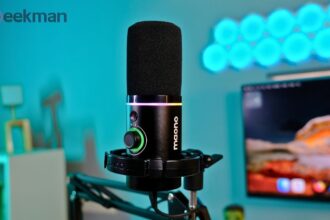

If you’re searching for the best USB microphone under 5000 in India, you’re in the right place. The budget mic market has exploded with options that offer surprisingly good sound quality, RGB looks, and features like touch mute or dual-output USB+XLR, whether you’re a podcaster, streamer, YouTuber, or just want cleaner voice for calls. With so many options out there, picking the right one for your setup and voice can get confusing.
In this article, I’ve handpicked the top USB microphones under 5000 Rs that genuinely stand out for their audio quality, build, and value. From bass-heavy dynamic mics that kill background noise, to bright condensers with RGB drama, to a premium pick worth stretching the budget for — there’s something here for every use case. Let’s dive into the best picks and find your next mic.
QUICK VERDICT
⚡ QUICK VERDICT
- Best Overall: MAONO PD200XS (₹4,999) — dynamic capsule that ignores your keyboard, fan and AC noise without any software
- Best For Gaming & Streaming: FIFINE A6T (₹4,990) — complete RGB kit with boom arm, touch mute, and 8,400+ Amazon reviews
- Best Value Dynamic: FDUCE SL40 (₹3,999) — all-metal USB+XLR that reviewers call a Shure MV7 alternative at one-fifth the price
- Best Budget Pick: MAONO AU-A04 (₹2,744) — cheapest complete YouTube kit in India, plug-and-play, no drivers needed
- Best Premium Pick (Stretch Budget): HyperX DuoCast (₹6,130) — dual polar patterns and HyperX build for creators who want to buy once
These are the best USB Microphones Under 5000 in India
MAONO PD200XS (USB-C + XLR)BEST OVERALL
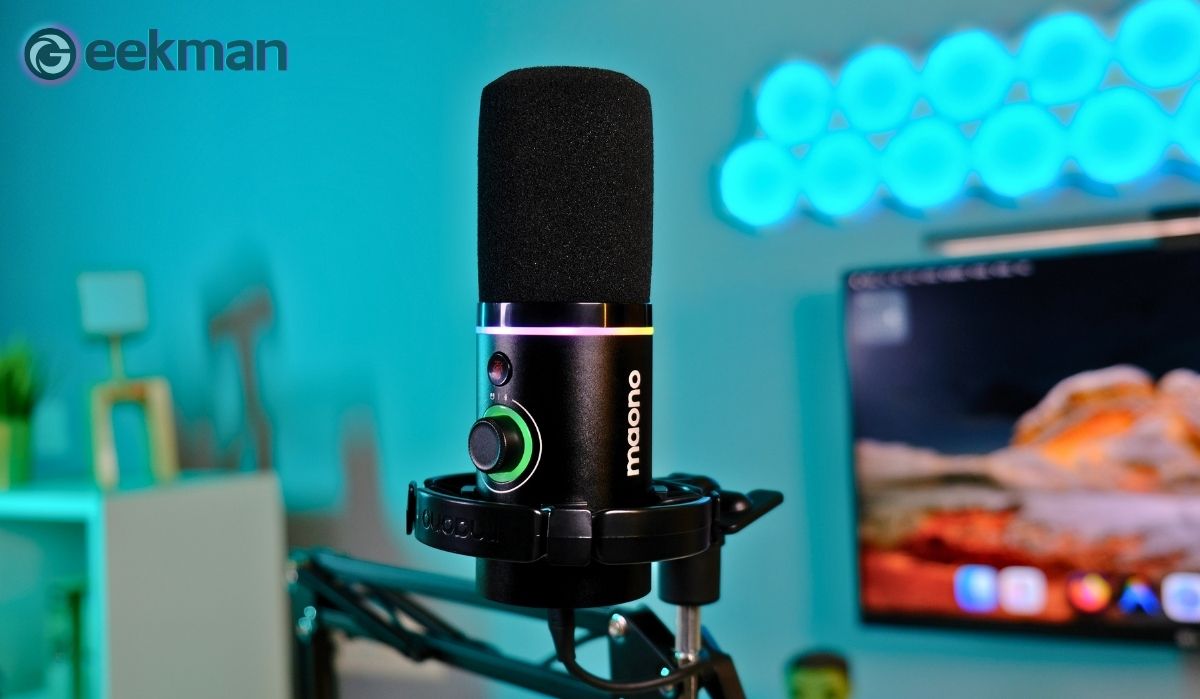
Buy the MAONO PD200XS at ₹4,999 if you record in any room with background noise and want one mic that grows from USB plug-and-play today to a full XLR setup tomorrow; get a condenser like the FIFINE A6T instead only if your room is treated and you specifically want brighter, airier vocals.
At ₹4,999, the PD200XS is the mic we’re currently testing for our upcoming Geekman review, and the story it tells the moment you plug it in is simple: the keyboard clicks, ceiling fan hum, and 3PM AC drone your laptop mic used to capture — gone. That’s the dynamic capsule doing what condensers physically can’t: only picking up what’s within 4-6 inches of the diaphragm. For any Indian creator working out of a shared flat or an unsoundproofed home studio, that alone is worth the ₹5,000.
Build & Controls
The PD200XS ships as a complete kit — the mic itself (a 500g metal cylinder about 6 inches tall), a black metal boom arm, and a shock mount that clamps to any desk up to 60mm thick. Front-facing controls sit exactly where your hand lands: a mute button on top, a 2-in-1 knob at the bottom that switches between mic gain and headphone volume, and a headphone jack on the back for zero-latency monitoring.
The RGB ring at the base cycles through nine preset colours, or you can turn it off entirely from the MAONO Link app if you’re recording a podcast where the desk stays in shot. The boom arm’s articulation isn’t as smooth as the FIFINE T669’s spring-loaded design, but the desk clamp is solid enough for almost every Indian gaming desk.
Sound Quality
The PD200XS is tuned warm. Male voices come through with real chest and body, female voices sit forward without any harsh top-end. The 40Hz-16kHz frequency response deliberately clips off the extreme highs — you don’t get the airy sparkle a condenser like the FIFINE A6T gives you on breathy vocals, but you don’t get the crispy sibilance either. For voiceovers, gaming commentary, and podcast talking-head duty, that tuning is honestly ideal.
The dynamic advantage shows up the moment you move your mouth 8 inches away — audio drops off a cliff. That’s the point. Keyboard clicks 12 inches to your right? Barely audible. Ceiling fan? Silent. This is why streamers who game with mechanical switches keep coming back to dynamics like the PD200XS — condensers pick up everything, dynamics only pick up you.
Software & Features
MAONO Link (Windows and Mac) is where the PD200XS actually earns its price. You get a parametric EQ, a compressor, a limiter, and 9-colour RGB control from one interface. The presets alone are worth the download — the “Podcast” and “Streamer” profiles give you a broadcast-radio warmth without needing OBS filters. One catch worth knowing: all software features only work in USB mode. Once you switch to XLR into a Focusrite Scarlett or similar interface, the software goes silent and you’re back to hardware-only.
Phone & Console Compatibility
Direct USB-C plug into any Android phone works out of the box — record voiceovers on your Pixel, OnePlus, or Samsung and the mic shows up as a source in Instagram, YouTube Shorts, or your recorder app. iPhone 15 and above (USB-C) also work direct. iPhone 14 and older need a Lightning-to-USB adapter that MAONO doesn’t include in the box — factor another ₹500-800 for a proper Apple adapter. Console-wise, PS4/PS5 support is confirmed, Xbox is not.
vs The Competition
Against the FIFINE A6T (#2 on this list), the PD200XS wins in a noisy room, the A6T wins if you want RGB drama and a brighter condenser sound. Against the FDUCE SL40 (#3), the PD200XS has software and a complete kit the SL40 doesn’t, but the SL40’s 20Hz-20kHz range picks up more high-end detail and comes with a 2-year warranty. If you’re upgrading from a headset mic and this is your first serious purchase, the PD200XS is the safest bet on this entire list.
Show more +Pros & Cons
Specifications
- Mic Type: Dynamic, cardioid pattern
- Frequency Response: 40Hz – 16kHz
- Sampling Rate: 24-bit / 48kHz
- Impedance: 600 Ohms
- Connectivity: USB-C + XLR (dual output)
- Enclosure: All-metal body, metal boom arm
- Weight: 1.13 kg (with boom arm)
- Cable: 2.5m USB-C to USB-A/C included; XLR cable not included
- Software: MAONO Link (EQ, compressor, limiter, RGB)
- Compatibility: Windows, Mac, Android (Type-C), iPhone 15+ (Type-C), PS4/PS5
- Warranty: 1 year manufacturer



FIFINE A6T (USB-C)BEST FOR GAMING & STREAMING
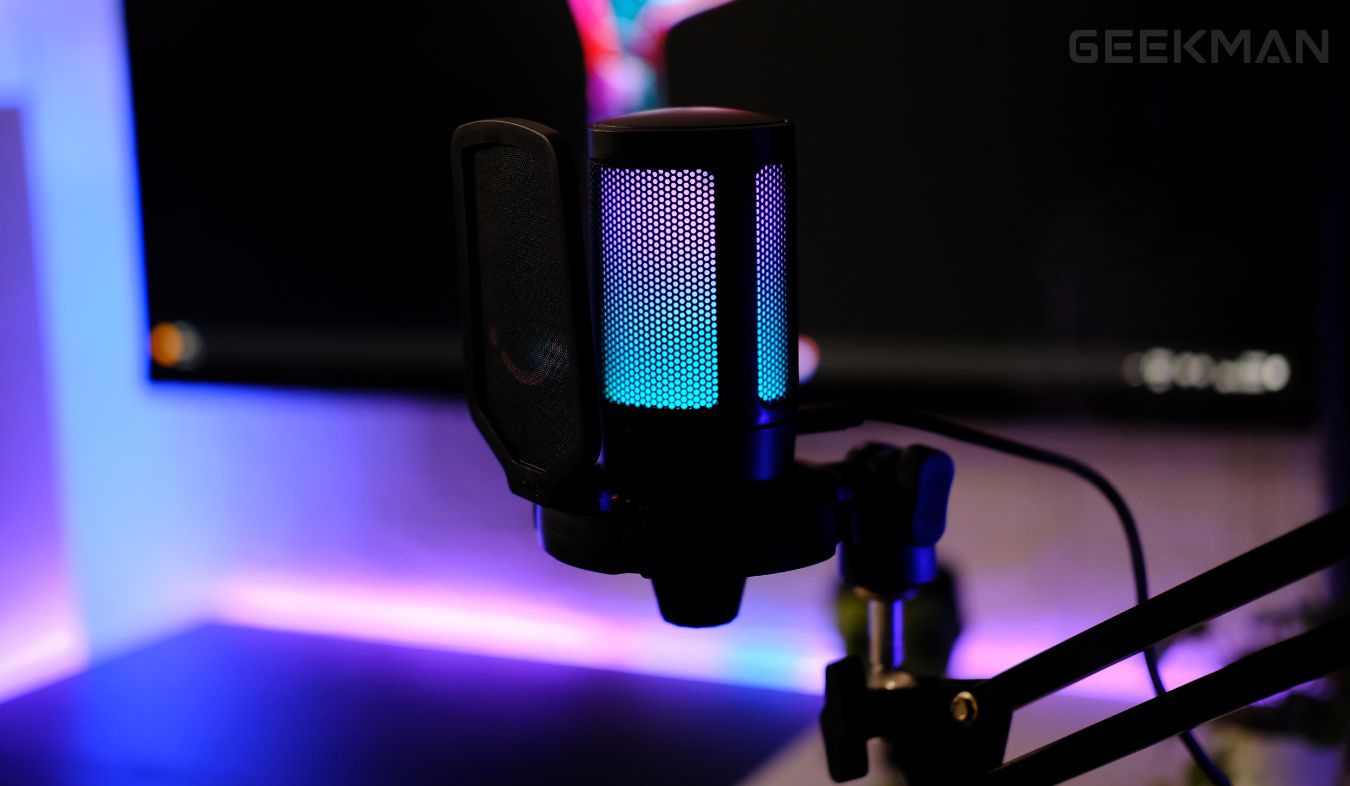
Buy the FIFINE A6T at ₹4,990 if you’re a streamer, gamer, or Reels creator who wants a complete RGB kit that arrives ready to plug in; skip it for the MAONO PD200XS if you record in a noisy room where a dynamic capsule matters more.
At ₹4,990, the A6T is what happens when a company decides to stop selling components and starts selling ready-to-stream setups. You get the mic, a spring-loaded boom arm, a shock mount, a pop filter, a gain knob, touch mute, and gradient RGB — one Amazon box, one USB-C cable, done. That’s why 8,400+ reviewers on Amazon India keep rating it 4.3 stars: it works the moment you plug it in, and it looks good enough to stay on camera.
FIFINE AmpliGame A6V Review — the budget sibling of the A6T
Build & Design
The A6T is a side-address mic — you talk into the front face, not the top — which is important because a lot of first-time buyers point it wrong and complain about muffled sound. The mic body is metal, the boom arm is spring-loaded and clamps to a 55mm desk edge, and total weight with the arm is about 900g. Compared to its budget sibling the A6V (which uses a plastic body and tripod), the A6T’s metal shell and boom arm are the two upgrades that justify the extra ₹1,500-2,000 gap.
The gradient RGB ring at the base runs through seven pre-set colour patterns automatically. Tap the top of the mic and it mutes instantly, with the RGB switching colour so you have visual confirmation. This is a design detail streamers who juggle Discord, OBS and BGMI at the same time genuinely appreciate.
Sound Quality
The A6T uses a cardioid condenser capsule with a 60Hz-18kHz frequency response and a 70dB signal-to-noise ratio. In practice, that means voices come through with real presence and clarity — noticeably brighter and airier than the dynamic PD200XS above. For gaming commentary, Discord voice chat, and streaming with music underneath, that brightness reads as “professional” rather than “harsh”. Blue Yeti X puts more body into a voice, but you can close most of that gap with a light EQ pass in OBS.
Where it struggles is the same thing every condenser at this price struggles with: it hears everything. Your mechanical keyboard, the fan you have on because it’s Bangalore in August, the auto-rickshaw outside — all of it makes it into your recording unless you use NVIDIA Broadcast or OBS’s built-in noise suppression. That’s not an A6T flaw, that’s condenser physics — but worth knowing before you buy.
Streaming & Console Support
USB-C plug straight into your PS4 or PS5 works with no adapters — that’s a rare feature in this price bracket. On PC, it’s plug-and-play in OBS, Streamlabs, Discord, Zoom, and Google Meet the moment Windows or macOS recognises it. There’s no software suite to install (FIFINE keeps it hardware-only), which some users appreciate and some miss when they want deeper EQ control.
Long-Term Reliability
Multiple Amazon reviewers report an auto-mute bug developing after roughly 18 months of heavy daily use — the touch-mute pad becomes overly sensitive and triggers accidentally. It’s a known issue, not a dealbreaker, but factor it in if you’re planning to keep this mic for 3+ years. Most users report zero issues in the first 12-15 months, which covers the warranty period.
vs The Competition
Against the MAONO PD200XS (#1 on this list), the A6T sounds brighter and includes RGB drama the PD200XS keeps subtle; the PD200XS wins in noisy rooms and future-proofs with XLR. Against the MAONO AU-A04 (#4), the A6T has RGB, touch-mute, and USB-C where the AU-A04 has none, but the AU-A04 costs ₹2,250 less. Pick the A6T if your setup is on-camera; pick the AU-A04 if it isn’t.
Show more +Pros & Cons
Specifications
- Mic Type: Condenser, cardioid pattern
- Frequency Response: 60Hz – 18kHz
- SNR: 70 dBImpedance: 2.2 kOhms
- Connectivity: USB-C
- Enclosure: Metal body
- Weight: 900g (with boom arm)
- Cable: 8.2ft (2.5m) USB-C, reversible connector
- Features: Gradient RGB ring, touch-mute pad, gain knob
- Compatibility: Windows, Mac, PS4, PS5
- Warranty: 1 year manufacturer

HyperX DuoCast (USB-C)BEST OVERALL
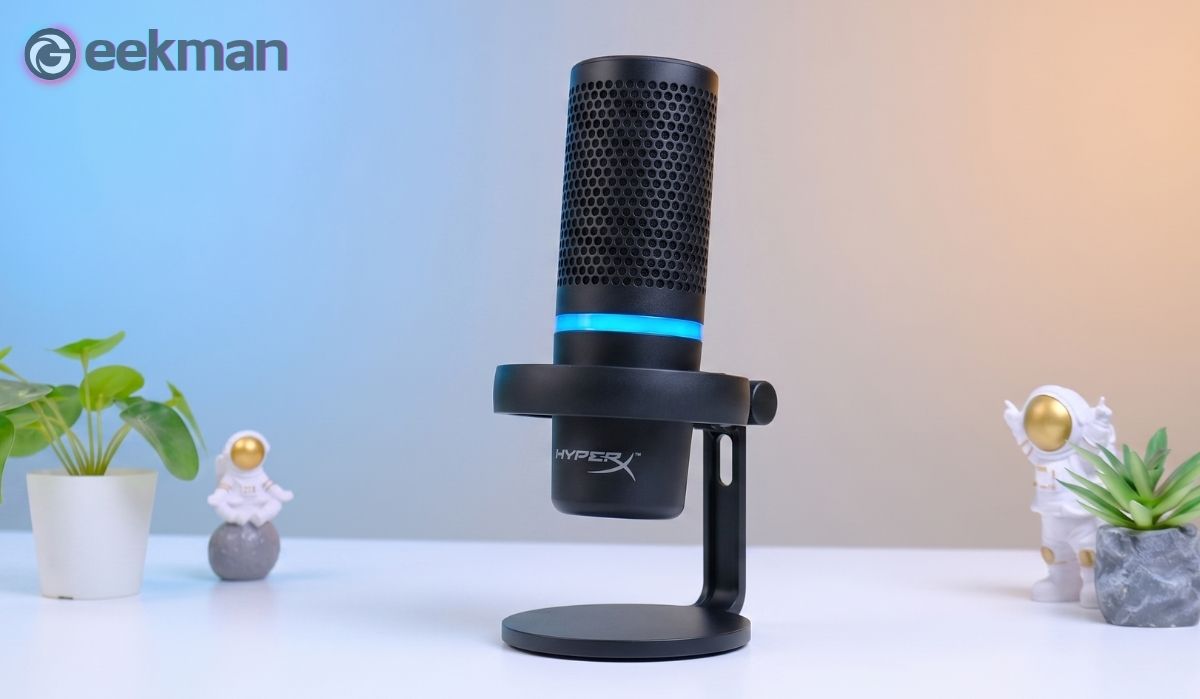
Buy the HyperX DuoCast at ₹6,130 if you want a premium condenser with dual polar patterns and 4-5 year longevity; stay with the FIFINE A6T at ₹4,990 if the extra ₹1,000+ pushes past your comfort zone.
At ₹6,130-9,999 the HyperX DuoCast pushes past our ₹5,000 target, and we’re upfront about that. It earns its place anyway: two selectable polar patterns (cardioid for solo, omnidirectional for group calls), 24-bit/96kHz recording, a genuinely tasteful RGB ring built into a low-profile shock mount, and HyperX’s brand reliability that most Amazon-first Chinese brands can’t match. If you plan to buy one mic and use it for the next 4-5 years, this is the safest pick on the list.
Build & Design
The DuoCast is HyperX’s mid-tier mic between the entry-level SoloCast and the premium QuadCast. It’s the shortest of the three, with a low-profile shock mount that clips directly to the mic base rather than needing an external cradle. That means it takes less desk space than almost any other USB mic in this list — genuinely useful if your desk is a bedroom desk juggling monitor, laptop, and mic in one 90cm strip.
The RGB is HyperX’s calling card — a subtle ring at the top of the mic that syncs with other HyperX peripherals (headset, keyboard, mouse) through NGENUITY software. If you already have a HyperX setup, the DuoCast looks like it belongs. If you don’t, the RGB stays subtle enough that it doesn’t scream “gamer mic” on a professional Zoom call.
Sound Quality & Polar Patterns
Sound reproduction is a genuine strength — TechRadar called it “fantastic” and SoundGuys rated it a “solid choice” with the caveat that you need a quiet recording environment. That caveat applies to every condenser at this price, but the DuoCast’s 24-bit / 96kHz sampling gives you noticeably more headroom to fix issues in post than the 16-bit or 24/48 mics elsewhere on this list.
The dual polar pattern switch is the standout feature. Cardioid mode picks up sound in front of the mic (solo podcasting, streaming, YouTube). Omnidirectional mode picks up sound from all directions (group calls, room ambience recording, casual conference-room use). Nothing else on this list under ₹5,000 offers both — you’d have to go up to the ₹10,000+ HyperX QuadCast to get more patterns.
Software: NGENUITY
HyperX NGENUITY (Windows only, no Mac) lets you customise the RGB ring and adjust some audio settings, but it’s genuinely cumbersome to use in real time — TechRadar called it out specifically. MAONO Link on the PD200XS is more polished for actual audio work. If you want deep software control, the PD200XS is the better pick. If you’re happy with hardware-only control and just want the RGB customised once, NGENUITY is fine.
Console & Multi-Device Support
PC, Mac, PS4, PS5 all supported natively, plus Discord and TeamSpeak certification for professional voice chat clarity. Xbox is not supported (like most USB mics). If you split time between PC gaming and PS5 streaming, the DuoCast handles both without any adapter switching.
vs The Competition
Against the FIFINE A6T (#2 on this list), the DuoCast has 24-bit/96kHz audio and dual polar patterns the A6T doesn’t; the A6T saves you ₹1,000+ and includes a boom arm. Against the MAONO PD200XS (#1), the DuoCast is a condenser (better for quiet rooms, worse for noisy ones); the PD200XS is dynamic (opposite trade-off). Against the HyperX QuadCast (₹10,000+), the DuoCast has two polar patterns instead of four; the QuadCast justifies the extra ₹4,000 only if you record vocals in stereo or bidirectional configurations.
Show more +Pros & Cons
Specifications
- Mic Type: Condenser
- Polar Patterns: Cardioid + Omnidirectional (switchable)
- Sampling Rate: 24-bit / 96kHz
- Connectivity: USB-C
- Enclosure: Metal body with low-profile shock mount
- Features: RGB ring, tap-to-mute LED, gain knob, internal pop filter, headphone jack
- Software: HyperX NGENUITY (Windows only)
- Compatibility: PC, Mac, PS4, PS5 (no Xbox)
- Certifications: Discord, TeamSpeak
- Warranty: 2 years HyperX India warranty

FDUCE SL40 (USB-C + XLR)BEST Podcast mic under 5000 — USB/XLR DYNAMIC
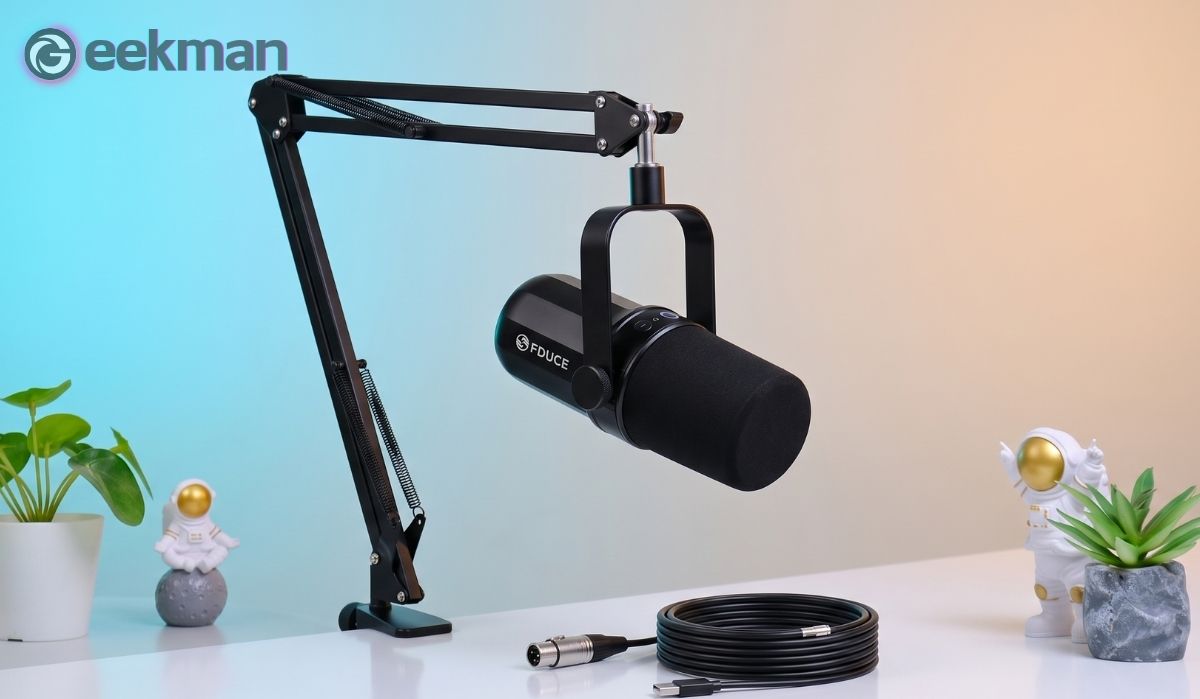
Buy the FDUCE SL40 at ₹3,999 if you want a USB/XLR dynamic with a wider frequency range than the PD200XS and a 2-year warranty; skip it if you specifically want MAONO Link software or the RGB drama the FIFINE A6T brings.
The FDUCE SL40 at ₹3,999 is one of those quiet Indian creator secrets that YouTube reviewers rate higher than Reddit gives it credit for. All-metal body, USB and XLR both, wider frequency range than the MAONO PD200X at a lower price, and a 2-year warranty most premium brands don’t even bother offering. American reviewers have straight-up called it a Shure MV7 alternative — the MV7 costs ₹22,000+ in India.
Build & Design
The SL40 is the shortest dynamic mic on this list at 155mm — that’s 157mm shorter than a Shure MV7, and the difference matters when you’re setting up in a small home studio or bedroom podcast rig. The all-metal chassis weighs a solid 655g without any accessories, which is heavy for its size — that’s a good sign, cheap plastic mics on Amazon feel weightless. Silicone-touch buttons for LED mute and volume/gain switching keep the whole thing feeling considered rather than budget-cornered.
The base SL40 comes as the mic only. If you want a boom arm and shock mount in the same box, the SL40+ variant (₹5,034) and SL40X kit (₹7,618) exist — but if you already own a boom arm, the base variant is the smarter buy.
Sound Quality
The SL40 tunes bass-forward, which is either your favourite thing or your first EQ adjustment depending on your voice. Male voices get real warmth and depth without any post-processing; female voices sometimes want a mild low-cut around 100Hz to sit forward in the mix. The 20Hz-20kHz frequency response is genuinely wider than the PD200XS’s 40Hz-16kHz — which translates to a bit more air on the top end and more sub-bass extension at the bottom.
FDUCE calls it “Voice Isolation Technology” which is marketing speak for standard dynamic-mic close-pickup — get within 4 inches of the capsule and the mic reads your voice clean; step back 8 inches and everything drops off. Same physics as the PD200XS, same rule for use: close-mic technique matters more than any spec sheet.
Phone & Android Compatibility
FDUCE officially lists Android compatibility — plug the included USB cable into any Type-C phone with an OTG adapter and it works. iOS compatibility is also listed. That’s a bigger deal than it sounds: a lot of dynamic mics at this price don’t play well with phones because they need more preamp gain than a phone can supply. The SL40’s built-in preamp handles this well enough that mobile podcasters can genuinely use it as a portable rig.
vs The Competition
Against the MAONO PD200XS (#1 on this list), the SL40 wins on frequency range and warranty length, the PD200XS wins on software and complete-kit convenience. Against the Shure MV7 (₹22,000+), American reviewers put both on the same podcasting shortlist — the MV7 has better companion software and Shure’s brand reliability, the SL40 is one-fifth the price with 80% of the audio quality. Against the FDUCE SL40+ variant (₹5,034), you’re paying ₹1,000 more for a boom arm you might not need if you already own one.
Show more +Pros & Cons
Specifications
- Mic Type: Dynamic, cardioid pattern
- Frequency Response: 20Hz – 20kHz
- Sampling Rate: 24-bit / 96kHz
- Impedance: 314 Ohms
- Connectivity: USB + XLR (dual output)
- Enclosure: All-metal body
- Weight: 655g (mic only)
- Cable: 2m USB cable included
- Features: LED mute button, headphone jack, volume/gain knob
- Compatibility: Windows, Mac, Android, iOS
- Warranty: 2 years manufacturer

MAONO AU-A04 (USB Type-B)BEST BUDGET / YOUTUBE VOICEOVER
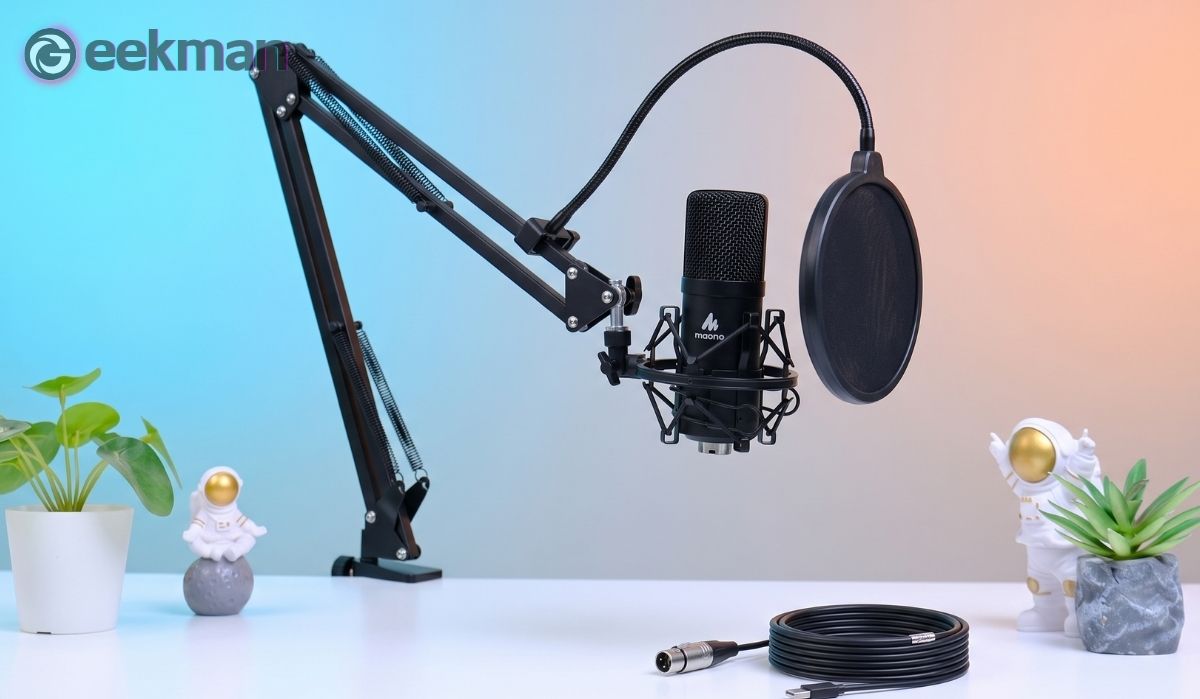
Buy the MAONO AU-A04 at ₹2,744 if you’re starting a YouTube channel or podcast and need a complete kit for the lowest possible price; skip it for the FIFINE A6T if you need RGB, USB-C, or PS4/PS5 support.
The MAONO AU-A04 at ₹2,744 is the mic that has quietly launched more Indian YouTube channels than any other name on this list. It’s not the newest, it’s not the flashiest, but the box arrives with everything you need — a scissor boom arm, shock mount, pop filter, foam windscreen, and the mic itself — and it works the moment you plug the USB cable into your laptop. No drivers, no phantom power, no audio interface, nothing extra to buy. Every rupee goes into the recording.
Build & What’s In The Box
The AU-A04 has been on Amazon India since 2019, and the design shows its age in a couple of places — the USB-B port on the back is the biggest tell (most 2026 mics use USB-C). But the body itself is metal, the scissor arm is genuinely sturdy (rated for a 1.5kg mic load), and the shock mount holds the mic tight without slipping. This is 2019 build quality at 2019 pricing, which turns out to still be a good deal in 2026.
The pop filter clips onto the arm with a metal gooseneck, positioned in front of the mic. The foam windscreen slips over the mic body for outdoor use or extra plosive protection. Between the two, the AU-A04 kit handles harsh “P” and “B” sounds better than mics twice its price that ship without either.
Sound Quality
The 16mm electret condenser capsule delivers a flat, natural sound signature — not exciting, not exaggerated, just accurate. Vocals come through clean and centred, with a slight low-end warmth from the 30Hz frequency response floor. For voiceovers, tutorials, and podcast talking-head duty, that flatness is a feature — you can EQ it in post to sit exactly where your channel’s sound needs it. The 192kHz/24-bit sample rate is honestly overkill for YouTube (which caps at 48kHz), but future-proofs you if you ever move into music or long-form audio work.
The condenser sensitivity trade-off applies here too: keyboard clicks, chair squeaks, and ambient room noise will make it into your recording. Solve it the same way every budget condenser buyer solves it — record in a soft-furnished room (throw a blanket over the desk if you have to), use OBS or Audacity’s built-in noise suppression, and keep the mic 4-6 inches from your mouth.
Why It’s Still Relevant In 2026
Newer mics like the FIFINE A6T at ₹4,990 have RGB, touch-mute, and USB-C — but they cost roughly double. If you’re on a genuine budget, or you’re buying your first mic and not sure if podcasting is going to stick as a hobby, the AU-A04 answers the question “will this work?” with a clear yes — for less money than any competitor in this segment.
vs The Competition
Against the FIFINE A6T (#2 on this list), the AU-A04 saves you ₹2,250 by dropping RGB, USB-C, and touch-mute; the A6T earns the premium if you’re on-camera. Against the FIFINE T669 (₹3,990), the AU-A04 is functionally identical for less money; the T669 has a slightly wider frequency range (20Hz-20kHz vs 30Hz-16kHz). Against the FIFINE K669B (₹2,690), the AU-A04 gives you the boom arm and pop filter the K669B doesn’t include, which is easily ₹800 of accessories.
Show more +Pros & Cons
Specifications
- Mic Type: Condenser, cardioid pattern
- Frequency Response: 30Hz – 16kHz
- Sampling Rate: 192kHz / 24-bit
- Transducer: 16mm electret condenser
- Connectivity: USB (Type-B to Type-A)
- Enclosure: Metal body
- Kit Includes: Scissor boom arm, shock mount, pop filter, foam windscreen, USB cable
- Compatibility: Windows, Mac, PS4, Linux
- Warranty: 1 year manufacturer

Quick Comparison Table
| Model | Price | Best For | Connectivity | Mic Type |
|---|---|---|---|---|
| MAONO PD200XS | ₹4,999 | Overall / noisy rooms | USB-C + XLR | Dynamic |
| FIFINE A6T | ₹4,990 | Streaming / gaming / RGB | USB-C | Condenser |
| FDUCE SL40 | ₹3,999 | Podcasting / value | USB + XLR | Dynamic |
| MAONO AU-A04 | ₹2,744 | Budget / YouTube voiceover | USB-B | Condenser |
| HyperX DuoCast | ₹5,230 | Premium / dual polar patterns | USB-C | Condenser |